{Why changing is less about adding something new, and more about loosening the grip of something old.}
Sunita heard it before she could stop it.
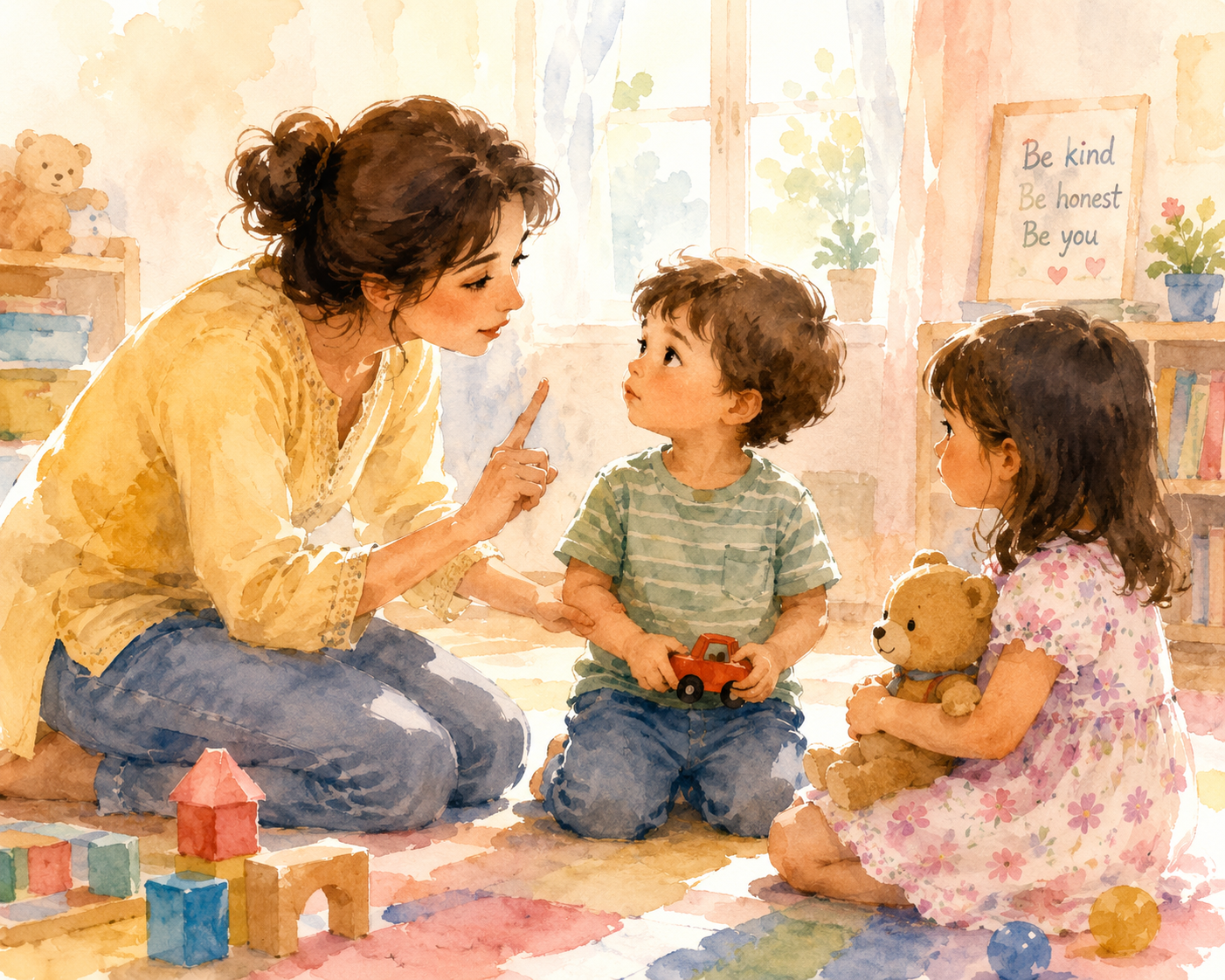
Her nine-year-old had spilled a glass of milk across the table, and the words came out of her mouth in a voice that wasn't quite hers.
"Can't you do anything properly?"
Her son's face fell. And in that half-second, Sunita froze. Because she knew exactly where that sentence had come from. She had heard it a hundred times in her own childhood kitchen. In her mother's voice. Over a different table, in a different city, thirty years ago.
She had promised herself she would never say it.
She had read the parenting books. She had learned about gentle discipline and emotional coaching. She had added so much new knowledge.
And still, the old sentence had arrived first.
This is the thing nobody tells us about becoming the person we want to be. It is not mainly about learning. Most of us already know what we should do. The harder work is unlearning what is already in there, running quietly underneath, arriving before we have time to think.
What Unlearning Actually Means
We usually imagine change like upgrading a phone. Delete the old version, install the new one, done.
That is not how minds work.
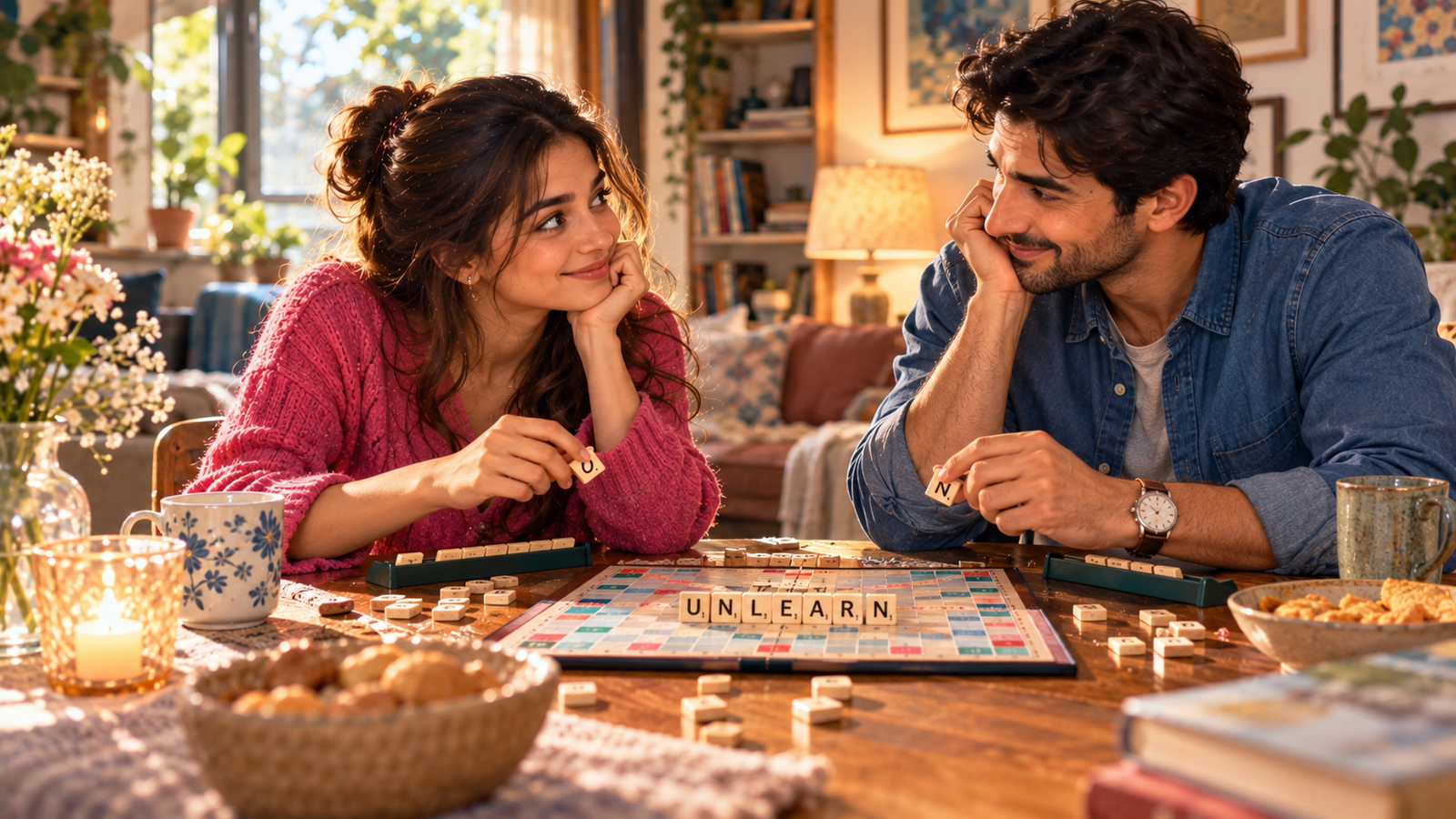
Unlearning is not deleting. You cannot reach into your head and remove the sentence your mother used to say. What you can do is build something new, right beside it, and practise it until the new thing gets there first.
Think of a field with a well-worn path across it. You have walked that path so many times that your feet find it in the dark. You cannot make the path disappear. But you can start walking somewhere else. And slowly, with every crossing, the new route becomes clearer while the old one grows over.
The old path stays. It just stops being the one you take.
Keep that picture. It explains almost everything that follows, including why you sometimes end up back on the old path without meaning to.
The Quote Everyone Shares, and Nobody Checks
There is a famous line about this, which you have probably seen on a poster.
"The illiterate of the 21st century will not be those who cannot read and write, but those who cannot learn, unlearn and relearn."
It is nearly always signed Alvin Toffler.
Here is the interesting part. Toffler didn't quite say it. In his 1970 book Future Shock, he wrote that adding learn, unlearn and relearn to education would open a powerful new dimension. In the very next paragraph, he quoted a psychologist named Herbert Gerjuoy, who said tomorrow's illiterate would not be the person who couldn't read, but the person who had never learned how to learn.
The crisp version we all share is a later blend of the two.
I mention this not to be pedantic, but because it is such a neat example of the thing itself. We absorb something. We repeat it for years. We never go back and check. That is exactly how beliefs about ourselves work too.
Why Unlearning Is So Much Harder Than Learning
In 1942, a psychologist called Abraham Luchins gave people a puzzle about measuring water using three jars of different sizes.
He started them with several problems that all needed the same fairly long method. His participants learned it well.
Then he gave them problems that could be solved in a much simpler way, with two jars instead of three. Almost nobody saw it. They kept grinding through the long method they had learned, even when the easy answer was sitting right in front of them.
Psychologists named this the Einstellung effect: a familiar solution blocking a better one.
Decades later, researchers tried it with chess masters. They set up positions containing a familiar winning move and a better, less obvious one. Many strong players missed the better move entirely. And when the researchers tracked their eyes, they found something fascinating. Even while the players insisted they were searching for something new, their eyes kept returning to the squares belonging to the old, familiar solution.
That is the whole problem, in one sentence. Knowing something already quietly tells your attention where to look.
This is why smart, well-read, well-intentioned people go on repeating patterns they have already decided are wrong. Not because they lack information. Because the old pattern gets to the door first.
What Brain Science Says (and Why It Should Reassure You)
Now the part that I think every parent deserves to know.
Psychologists have spent decades studying what happens when a learned response fades away. The technical word is extinction, and for a long time people assumed it meant erasing.
It doesn't.
Study after study has shown that when an old response disappears, the original learning is still sitting there, intact. What has happened is that the brain has built a second, competing pattern that holds the first one back. Two memories now exist side by side, and whichever is stronger in that moment wins.
Which explains three things you have almost certainly experienced.
You slip back when you are stressed. New learning is more fragile than old learning. Under pressure, exhaustion or fear, the older, deeper pattern is the one that surfaces.
You slip back in old places. Researchers call this renewal. A pattern you have thoroughly changed can reappear the moment you return to the setting where you first learned it. This is why so many people find themselves behaving like a teenager within twenty minutes of arriving at their parents' home.
You slip back after a long stretch of doing well. They call this spontaneous recovery. The old response can resurface simply with the passing of time, even when nothing has gone wrong.
Please read this next line slowly, because it may be the most useful sentence in this article.
Slipping back is not failure. It is exactly what the science predicts.
You have not undone your progress. Your new path is still there. The old one simply won that particular moment, in that particular kitchen, on that particular tired evening. Tomorrow, you get to walk the new one again.
What Most of Us Need to Unlearn
Unlearning is not really about facts. It is about the quiet rules we absorbed before we could examine them.
Here are some of the commonest, and what might take their place.
|
The old rule |
What could replace it |
|
Love must be earned by achieving |
I am worth loving as I am |
|
Anger and tears are bad behaviour |
All feelings are allowed; not all actions are |
|
Asking for help is weakness |
Asking for help is a skill |
|
A good parent always knows what to do |
A good parent keeps learning and repairs mistakes |
|
Rest must be earned |
Rest is part of being well, not a reward |
|
Marks measure a child's worth |
Marks measure one narrow thing on one particular day |
|
Disagreement means disrespect |
Disagreement can be a sign of trust |
|
If I say sorry, I lose authority |
Apologising builds authority that lasts |
You will notice that most of these were never taught to us deliberately. Nobody sat us down and said rest must be earned. We absorbed it from watching the adults around us, and we have been quietly obeying it ever since.
That is what makes unlearning such intimate work. You are not arguing with a book. You are arguing with something that feels like simply how things are.
How to Actually Unlearn Something
1. Catch it in the act. You cannot change something you cannot see. For a week, just notice. What sentence came out of your mouth that you didn't choose? What made you tense for no clear reason? Don't judge it. Just notice it, the way you would notice the weather.
2. Ask where it came from. When you catch a pattern, ask gently: Whose voice is this? Where did I learn it? Often the answer arrives instantly, and the recognition itself loosens the grip. A rule that came from somewhere can be questioned. A rule that feels like reality cannot.
3. Ask whether it was ever true. And this matters: whether it is true now. Many of our oldest rules were once useful. A child who learned to keep quiet in a tense house was being wise, not weak. That rule protected her. It simply doesn't serve the adult she has become. You can thank an old rule for what it did, and still set it down.
4. Decide what goes in its place. This is the step most people skip, and it is the one that decides everything. You cannot simply remove a pattern and leave a hole. Something will fill it, and by default it will be the old thing.
So be specific. Not "I'll stop shouting", but "When I feel the heat rising, I will say: I need a minute, and I'll come back." Not "I'll stop putting myself down", but "When I catch myself saying I'm useless at this, I'll say instead: I haven't learned this yet."
Write the new sentence down. You will need it in a hurry one day.
5. Practise on easy days. A new pattern learned only in crisis will not hold in crisis. Practise the pause when you are calm. Practise the new sentence when nothing much is at stake. Give it enough repetitions to stand a chance when the hard moment comes.
6. Change the setting where you can. Since old patterns are triggered by old surroundings, small changes to the situation help more than willpower. If arguments always begin at the dinner table, try walking. If bedtime is where you lose your temper, start the routine twenty minutes earlier.
7. Expect the old path, and plan your return. You will slip. Everyone does. The question that matters is not did I fall back? but how quickly did I return? Say it plainly to yourself: That was the old path. I know that one. Let me start again.
For Parents: The Cycle Is Not Inevitable
If you grew up in a home where feelings were dismissed, or where love felt conditional, you may carry a quiet fear that you will hand the same thing down to your children.
Here the research offers something genuinely hopeful.
Studies consistently show that parents tend to pass on their own attachment patterns. But they also show something else: this transmission is not inevitable. And researchers have identified what makes the difference.
It is called reflective functioning, and it is a simple idea with a heavy name. It means the ability to pause and think about what is going on inside people, including yourself. To recognise that your child has their own thoughts and feelings, separate from yours. And to make some sense of your own history.
In a well-known longitudinal study of parents and children, mothers who could reflect on their own childhoods in a coherent, thoughtful way were more likely to have securely attached babies. Strikingly, this held true even for mothers who had been through painful or frightening experiences of their own. It was not the absence of hardship that protected their children. It was having made sense of it.
Let me put that plainly, because it is worth carrying with you.
What shapes your child is not what happened to you. It is how well you have come to understand what happened to you.
This is unlearning at its most important. You will never delete the voice from your childhood kitchen. But you can know it when you hear it. You can pause. And in that pause, you can choose the other path.
Raising Children Who Can Change Their Minds
The best gift here is a child who never needs to unlearn quite so much, because they learned to hold their ideas a little more lightly from the start.
Let them see you change your mind. "I used to think that. I've read more about it since, and now I think differently." Children who watch adults update their thinking learn that it is safe, and even admirable, to do so.
Praise the effort, not the label. A child who believes she is clever has something to protect. A child who believes she gets better by working has something to build. The second child will find it far easier to be wrong.
Welcome good questions, including awkward ones. When a child asks why do we do it that way?, resist because that's how it's done. Try that's a good question, let's think about it. You are teaching them that traditions can be examined without being destroyed.
Separate the idea from the person. Teach them early: You can disagree with an idea and still love the person. This single distinction will protect their friendships, their marriage and their mind.
Let them be wrong without shame. A child who is mocked for a mistake learns to defend her position rather than examine it. A child who hears good, now we know something new learns that being wrong is simply part of getting it right.
Be Patient With Yourself
Unlearning is slow, and it is quietly emotional work. You are letting go of things that once kept you safe. Sometimes there is grief in that, and grief deserves patience.
Go gently. Choose one pattern, not ten. Expect to slip back, especially when you are tired, and especially in your parents' house. Notice the small wins that nobody else will see, the shout you didn't shout, the apology you managed. Those are the crossings that wear the new path in.
And be careful of turning this into one more way to fail. If you find yourself saying I should have unlearned this by now, notice that. That is an old rule too.
Back at the Kitchen Table
Let us return to Sunita, standing in her kitchen with a spilled glass of milk and a sentence she never wanted to say.
Here is what happened next.
She took a breath. She crouched down to her son's level. And she said, "I'm sorry. That came out wrong, and it wasn't fair. It's only milk. Let's clean it up together."
Then she added something she had never heard as a child: "You didn't do anything wrong."
The old path was still there. It always will be. But that evening, for the first time, she stepped off it while she was still standing on it.
That is unlearning. Not becoming a different person. Not deleting your past. Just catching the old sentence as it arrives, holding it for a moment, and choosing another one.
Become who you want to be, one crossing at a time.
"You cannot erase the old path. You can only wear in a new one, step by patient step."