(On honesty, curiosity, and the quiet power of not having all the answers.)
"Mumma, do fish ever get thirsty?"
The question arrives from the back seat, somewhere between a traffic signal and the vegetable market. Anaya is seven. She asks questions the way other children breathe: constantly, without thinking, and as though her life depends on it.
Her mother opens her mouth to answer, and then pauses. Because the truth is, she has no idea. Fish live in water, so surely they can't be thirsty? Or can they? For a moment, she feels the familiar pull. She could say something that sounds right. No, beta, they're always in water, so they're never thirsty. Anaya would nod and move on to the next question, and no one would ever know.
Instead, she says something else.
"You know what? I don't know. That's a really good question. Shall we find out tonight?"
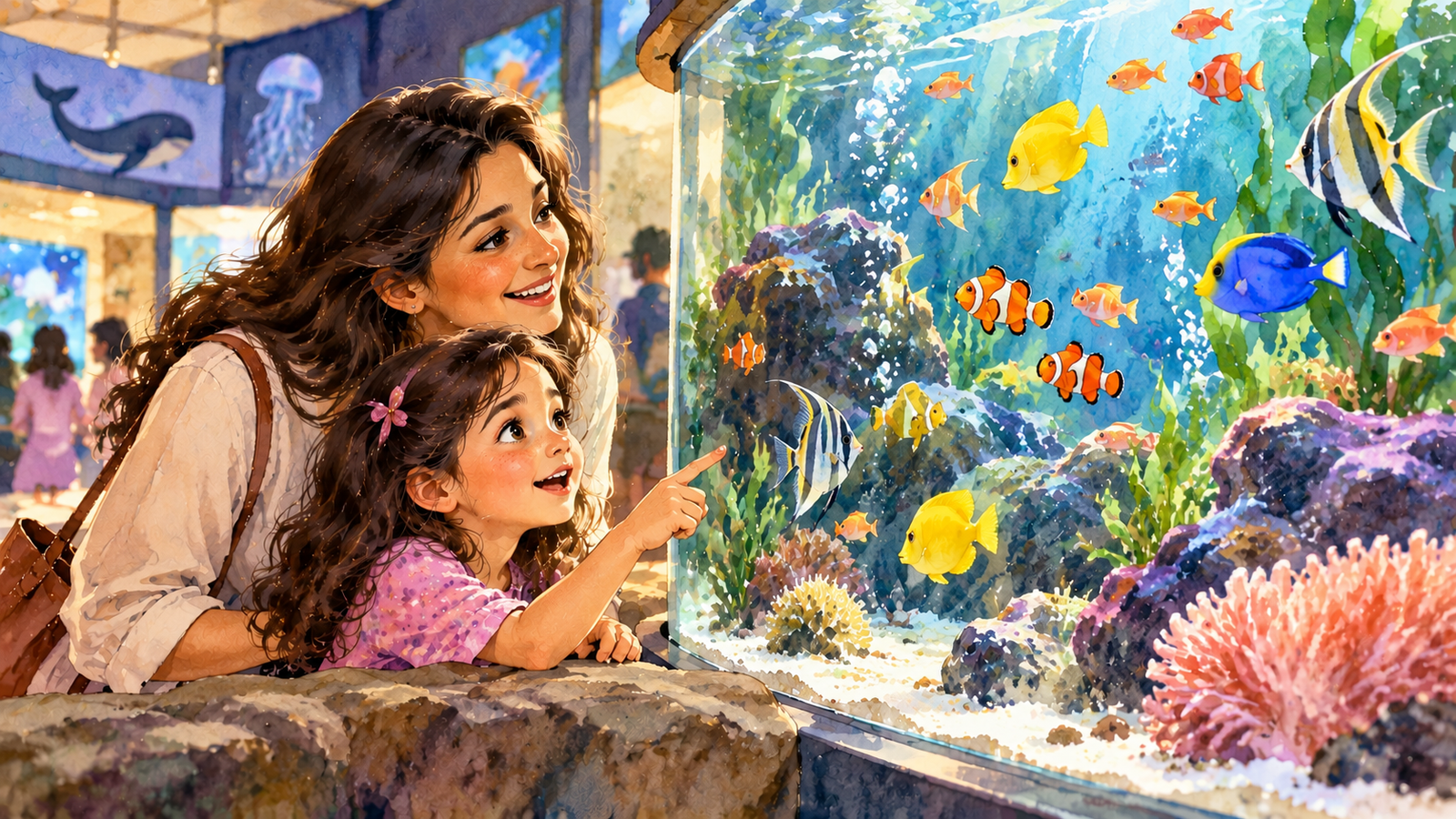
Anaya's face lights up as if she has just been handed a treasure map.
That evening, the two of them sit together and discover something neither of them expected: it depends on the fish. Fish in the salty sea actually drink water, and have special cells in their gills to push the extra salt back out. River fish hardly drink at all, because fresh water keeps seeping into their bodies on its own, so their challenge is getting rid of it. Anaya is delighted. She tells her grandmother. She tells her class. She tells the man at the fish counter, who is less delighted.
But something much bigger than a fact about fish was learned in that car. And it began with three small, brave words.
The Weight of Pretending to Know
In a world where adults are expected to have all the answers, admitting ignorance to a child can feel like a failure.
Many of us carry an unspoken belief that being a good parent or teacher means being an endless well of knowledge. We worry that saying "I don't know" will weaken our authority, or leave a child feeling that the grown-ups around them are not quite solid enough to lean on. So we bluff. We guess confidently. We change the subject. We say "Because that's just how it is," or "You'll understand when you're older."
And children ask a great deal. Researchers who have recorded young children's everyday conversations have found that they can ask dozens of questions in a single hour. Why is the moon following us? Where do dreams come from? Do ants have grandparents? No adult alive could answer all of them, and yet many of us feel quietly ashamed each time we can't.
Developmental psychology suggests something surprising and deeply freeing: the very thing we fear is often the thing a child most needs to see. Acknowledging our limits, honestly and warmly, is one of the most empowering gifts we can give a growing mind.
What a Child Really Learns When We Pretend
Children do not only learn from what we say. They learn, far more deeply, from what we do. Every interaction carries a hidden lesson beneath the visible one.
When an adult pretends to know everything, the visible lesson might be a fact about fish. But the hidden lesson is something like this: Not knowing is embarrassing. Grown-ups are supposed to have every answer. If you don't know something, hide it.
A child who absorbs that lesson may grow into a student who never raises a hand unless certain of being right. Who copies a friend's answer rather than admit confusion. Who feels a hot flush of shame every time a teacher asks a question they cannot answer. Who, years later, sits silent in a meeting rather than say "Could you explain that again?"
The psychologist Carol Dweck, whose work on the "growth mindset" has influenced classrooms around the world, has shown how powerfully children are shaped by the beliefs they form about ability and effort. Children who come to see intelligence as fixed tend to avoid challenges that might expose what they don't know. Children who see ability as something that grows are more willing to struggle, stumble, and try again.
When we pretend to know everything, we quietly teach the first belief. When we say "I don't know yet," we teach the second.
Modelling Curiosity and Intellectual Humility
There is a lovely phrase that researchers have begun to study with great interest: intellectual humility. It simply means recognising that our knowledge has limits, and being open to learning, questioning, and changing our minds.
Studies of intellectual humility in young people, including work by the psychologist Tenelle Porter and her colleagues, have linked it with greater openness to new ideas and a stronger motivation to learn. It turns out that knowing what you don't know is not a weakness in a learner. It is the doorway through which all learning enters.
And like most virtues, intellectual humility is not taught by lecture. It is caught, by watching the people we admire.
When a parent says "I don't know, let's find out together!", several beautiful things happen at once.
The question is honoured. The child learns that their curiosity matters, that it is worth pausing the car, the class, or the dinner for.
Learning becomes an adventure rather than a delivery. Instead of passively receiving a finished fact from above, the child becomes a fellow explorer. They search, wonder, guess, and discover. The knowledge they find this way belongs to them in a way that a handed-down answer never quite can.
Not knowing becomes normal. The child sees, with their own eyes, that even the most trusted grown-up in their life has gaps, and that those gaps are not frightening. They are simply the next place to go looking.
Learning becomes lifelong. A child who watches their parent or teacher still learning at thirty-five or sixty-five understands something that no textbook can teach: that learning is not a stage of life that ends with school. It is a way of living. A journey without a final destination.
The developmental psychologist Susan Engel, who has spent years studying children's curiosity, observed that genuine, curiosity-driven questions were surprisingly rare in many of the classrooms she studied. Children arrive at school bursting with wonder, and somewhere along the way, many learn to stop asking. One of the kindest things we can do is keep that wonder alive by showing them that the adults are still wondering too.
Children Can Tell When We're Bluffing
Here is something that every parent eventually discovers: children are far more perceptive than we give them credit for.
They notice the tiny hesitation before our answer. The way our voice goes a little too confident. The change of subject that arrives a little too quickly. Children have finely tuned intuition, and they can often sense when an adult is bluffing, even if they cannot yet put it into words.
Research supports what parents feel in their bones. Developmental psychologists such as Paul Harris and Melissa Koenig have shown that even preschool children keep careful track of who tells them the truth. In their experiments, young children who watched two adults name familiar objects, one correctly and one incorrectly, later preferred to learn new words from the adult who had been accurate. Children are not passive sponges. They are quietly deciding, all the time, whose words deserve their trust.
This means every bluff carries a cost. When a child eventually discovers that the confident answer they were given was wrong, and they usually do, they don't only lose a fact. They lose a little faith in the person who gave it.
Building Trust Through Honesty
This is where the paradox resolves itself beautifully.
We fear that saying "I don't know" will make children trust us less. In reality, it is precisely what makes them trust us more.
Think of it this way. An adult who has an answer for everything gives the child no way to tell the solid answers from the guesses. Every statement carries the same confident tone, so every statement is equally uncertain. But an adult who honestly says "I'm not sure about that one" gives the child an enormous gift: the ability to rely completely on the answers that adult does give.
When your child has heard you say "I don't know" about fish and planets and dinosaurs, then your "Yes, I'm certain, never touch a hot iron" and your "I promise I will pick you up at four" land with the full weight of truth. Honest boundaries create credibility. Transparency about what we don't know gives our knowledge its value.
There is also a deeper layer here, one that touches the heart of the parent–child relationship. Attachment researchers have long described a secure caregiver as a "secure base": a steady, trustworthy presence from which a child feels safe enough to go out and explore the world. A child who trusts that the adult beside them will always be honest can venture further, ask bolder questions, and face harder truths, knowing that the ground beneath them is real.
An adult who is honest about the limits of their knowledge does not weaken that base. They strengthen it. They become someone a child can believe, completely, for a lifetime.
Lessons From the Drama Room
Teachers who work through drama have understood this for a long time.
The great British drama educator Dorothy Heathcote developed an approach she called the Mantle of the Expert. In it, the teacher deliberately steps down from the role of all-knowing authority. The children are treated as the experts, running an imaginary enterprise, perhaps a museum, a rescue team, or an archaeological dig, and they must research, decide, and solve problems as though real people depend on them. The teacher becomes a collaborator, sometimes even playing a character who knows less than the children and needs their help.
Something remarkable happens in these rooms. Children who rarely speak begin to lead. Questions multiply. Learning becomes urgent, because it finally belongs to them.
The principle behind it is the same one at work in Anaya's back seat: when an adult makes room for not knowing, children rush in to fill that space with curiosity, courage, and thought.
How to Say "I Don't Know" Well
Saying "I don't know" is powerful, but how we say it matters. A few gentle practices can turn an honest admission into a genuine gift.
Say it warmly, without apology
There is no need for embarrassment in your voice. Say it with the same ease you would use to say "It's raining." "Hmm, I don't know. What a brilliant question." Your calm tells the child that not knowing is perfectly safe.
Invite their thinking first
Before rushing to search for the answer, ask: "What do you think?" or "How could we find out?" You may be astonished by the theories a seven-year-old can build. Guessing, reasoning, and testing ideas are the very muscles of scientific thinking.
Find out together, and follow through
This is the part that matters most. "Let's find out" is a promise, and promises build trust only when they are kept. Look it up together that evening. Visit the library. Ask someone who knows. Watch a short video side by side. If a question has to wait, write it down somewhere, a "wonder jar" or a notebook of big questions, and return to it.
Let them see you learn
Share your own moments of discovery. "I read something today I never knew before." "I got that wrong yesterday. Here's what I learned." A child who sees an adult delighting in new knowledge learns that the delight never has to end.
Be honest about the questions nobody can answer
Some of a child's questions touch the deepest mysteries: What happens when we die? Is there an end to space? Why do people hurt each other? It is honest and deeply respectful to say, "That's a question grown-ups have wondered about for thousands of years. Here's what some people believe, and here's what I think. What do you think?" Children can hold uncertainty far better than we imagine, especially when they hold it alongside someone they trust.
Don't let "I don't know" become a door that closes
There is a difference between "I don't know, let's find out" and "I don't know, stop asking." The first opens a world. The second shuts it. Honest ignorance is a gift only when it is followed by shared curiosity.
The Courage to Not Know
Perhaps the real reason "I don't know" feels so difficult is that it asks something of us. It asks us to let go of the need to appear perfect. To stand before a child not as an oracle, but as a fellow human being, still learning, still wondering, still growing.
That is not a lesser kind of authority. It is a truer one.
The children in our lives do not need adults who know everything. No such adults exist, and deep down, children know it. What they need are adults who are honest, curious, and brave enough to say, "I don't know. Let's find out together."
Years from now, Anaya may not remember what she learned about thirsty fish. But she may remember, somewhere deep inside, how it felt to have her question taken seriously. How it felt to go looking side by side. How it felt to discover that the grown-up she trusted most was still a learner too.
And one day, when a small voice from the back seat of her car asks something she cannot answer, she may smile, pause, and give the same gift she was given.
"I don't know. What a wonderful question. Shall we find out?"