{Why the most transformative changes rarely announce themselves, and how to start where you are, exactly as you are.}
❦
For years, Meenal told herself she would read more.
She loved books. She had loved them since she was a girl. But between work, cooking, homework, and the endless small emergencies of family life, there was simply never time. Every January she promised herself she would read a book a week. Every February, the promise quietly disappeared.
Then one morning, waiting for her tea to brew, she picked up a novel lying on the kitchen counter and read two pages. Just two. The next morning, she did it again. The tea took four minutes to brew. Four minutes became her reading time.
She never made a grand resolution. She never announced anything. She simply read a little while her tea brewed, most mornings, for a year.
By the following December, she had finished eighteen books.
But the most surprising thing wasn't the number. It was the small boy who had started appearing at the kitchen table each morning with a book of his own, sitting quietly beside his mother, reading while her tea brewed.
There is an old saying : Drop by drop, an ocean is formed. This article is about those drops: the small, quiet habits that, over time, shape who we become, and who our children become too.
❦
The Myth of the Grand Transformation
We love dramatic change. The new year's resolution. The complete lifestyle overhaul. The Monday when everything will be different. We imagine that a better life arrives in one heroic leap: a sudden burst of discipline, a total reinvention.
And yet, most of us know how that story usually ends. The gym membership fades by March. The strict new diet collapses under a birthday cake. The ambitious plan to wake at five every morning survives exactly four days.
This is not because we are weak. It is because we have misunderstood how change really works.
The truth is quieter, humbler, and far more hopeful. Lasting change rarely arrives with a bang. It grows slowly, almost invisibly, through small actions repeated day after day, until one day we look up and realise that our lives have changed.
Consider a simple piece of arithmetic, popularised by the writer James Clear in his bestselling book Atomic Habits. If you improve by just 1% each day for a year, the gains compound to roughly 37 times better by the end. If you get 1% worse each day, you decline almost to nothing. Life, of course, is not a maths equation, and real growth is never so neat. But the image captures a deep truth: small choices, repeated, matter enormously. The direction we are travelling in matters more than the size of any single step.
❦
Your Life Is Made of Habits
Here is something that surprised even the scientists who discovered it.
The psychologist Wendy Wood, one of the world's leading researchers on habits, found that about 43% of what people do each day is repeated in the same context, usually while they are thinking about something else. Almost half of our daily lives run on autopilot: how we wake up, what we eat, how we speak to our families, how we spend our evenings, even how we respond when we are upset.
This means that our habits are not a small part of our lives. In a very real sense, they are our lives. And it means something wonderful, too. If we can gently reshape our habits, we can reshape our days, and our days, added together, become our years.
How habits work. Research describes a simple loop at the heart of every habit. There is a cue: a time, a place, a feeling, or something that just happened. There is a behaviour: the thing we do. And there is a reward: the good feeling or result that follows. Repeat that loop often enough in the same setting, and the brain begins to link the cue directly to the behaviour. Eventually, we no longer have to decide. We just do.
This is why you brush your teeth without deliberating each morning. It is also why, the moment we sit on the sofa after a long day, our hand reaches for the phone before we have even thought about it.
❦
The Willpower Myth
Many of us believe that people who eat well, exercise regularly, and stay organised simply have more willpower than the rest of us. We picture them gritting their teeth and resisting temptation through sheer force of character.
Research tells a very different story.
The psychologists Brian Galla and Angela Duckworth studied people who score high on measures of self-control. They found that these people are not, in fact, constantly battling temptation. They experience less of it, because they have built beneficial habits that do the work for them. Their good behaviour has become automatic, so they rarely need to fight themselves at all.
This is liberating news. It means that the goal is not to become someone with iron willpower. The goal is to build habits so natural that willpower is hardly needed.
❦
How Long Does It Really Take?
You have probably heard that it takes 21 days to form a habit. It is one of the most widely repeated "facts" in self-help, and it is not true.
The idea seems to trace back to a 1960 book by a plastic surgeon, Maxwell Maltz, who noticed that his patients took about three weeks to get used to their new appearance. He was describing adjustment, not habit formation, but the number stuck.
The real science came in 2010, when Phillippa Lally and her colleagues at University College London followed 96 people as they tried to build a new daily habit, such as drinking water with breakfast, eating fruit at lunch, or going for a run. On average, it took 66 days for the new behaviour to feel automatic. But the range was enormous: anywhere from 18 to 254 days. Simple habits, like drinking a glass of water, settled in much faster than demanding ones like exercise. A later review of the research found similar results, with most habits taking around two months, and some far longer.
And there was one more finding, perhaps the most comforting of all. Missing a single day did not meaningfully disrupt the process. You do not have to be perfect. You simply have to keep returning.
So if your new habit still feels effortful after three weeks, nothing has gone wrong. You are simply in the middle of the journey. Be patient with yourself. Deep roots take time.
❦
The Science of Small: Seven Principles That Work
Research from psychology and behaviour science points to a handful of simple principles that make habits far more likely to stick.
1. Start absurdly small.
The Stanford behaviour scientist B.J. Fogg, author of Tiny Habits, famously suggests beginning with a habit so tiny it seems almost silly. Want to floss? Start by flossing one tooth. Want to exercise? Start with two push-ups. Want to read? Start with two pages. A tiny habit asks so little of us that we can do it even on our worst, most exhausted days. And once a habit exists, it can grow naturally. The aim at first is not to achieve much. It is to become the kind of person who shows up.
2. Anchor it to something you already do.
New habits need a cue, and the most reliable cues are habits we already have. Fogg calls these "anchors," and James Clear calls the technique "habit stacking." The formula is simple: After I [current habit], I will [new habit]. After I pour my morning tea, I will read two pages. After I drop the children at school, I will take a ten-minute walk. After I brush my teeth at night, I will write down one thing I'm grateful for.
This technique is backed by a large body of research on what psychologists call implementation intentions, specific plans for when and where we will act. In a major review of 94 studies, Peter Gollwitzer and Paschal Sheeran found that making these specific "if-then" plans had a medium-to-large effect on whether people actually achieved their goals. In one well-known exercise study, 91% of people who wrote down exactly when and where they would exercise followed through, compared with only around a third of those who didn't make such a plan. A vague intention like "I'll exercise more" leaves the decision for later. A specific plan makes the decision in advance.
3. Shape your surroundings.
Wendy Wood's research shows that our environment quietly steers our habits far more than we realise. So make good habits easy and unhelpful ones a little harder. Keep a book on your pillow and the phone charger in another room. Leave a bowl of fruit on the table and the biscuits in a high cupboard. Lay out tomorrow's walking shoes by the door. Every small bit of friction we add or remove changes what we do, often without any willpower at all.
4. Make it feel good, straight away.
Our brains learn habits through reward, and the reward needs to come quickly. Fogg recommends a tiny celebration the moment you complete a new habit: a smile, a quiet "yes!", a little fist pump. It may feel silly, but that burst of positive feeling helps the brain remember the behaviour. Enjoying the habit itself matters too. Choose a walk you love, a book that delights you, music that lifts you.
5. Never miss twice.
Life will interrupt your habits. Children fall ill, guests arrive, work piles up. The research shows that a single missed day does little harm. The danger lies in letting one miss become two, then three, until the habit quietly disappears. James Clear offers a simple rule: missing once is an accident; try never to miss twice. When you slip, simply begin again the next day, without guilt.
6. Let habits shape who you are.
Clear suggests focusing less on what you want to achieve and more on who you want to become. Instead of "I want to read eighteen books," try "I am a reader." Instead of "I must stop shouting," try "I am a calm parent who breathes before responding." Every small action becomes a quiet vote for the person you are becoming. Two pages is not much. But it is proof, each day, that you are a reader.
7. One habit at a time.
When we try to change everything at once, we usually change nothing. Choose one small habit. Let it settle and grow. Then add the next. Slow, steady growth is still growth, and it lasts.
❦
Gently Changing Unwanted Habits
Breaking a habit follows the same science in reverse.
Change the cue. Since habits are triggered by context, changing the context weakens them. If you always scroll your phone the moment you sit on the sofa, try charging the phone in another room, or sitting somewhere different in the evening.
Add friction. Make the unwanted habit a little harder. Log out of the app. Move the television remote to a drawer. Keep sweets out of sight. Tiny obstacles make a surprising difference.
Replace, don't just remove. A habit leaves an empty space, and something will fill it. If evening scrolling is how you unwind, choose a different way to unwind: music, a short walk, tea on the balcony, a chat with your partner.
Use life's natural fresh starts. Research by Wood and others suggests that when our surroundings change, such as a move, a new job or a new school year, old habits lose their grip, because their familiar cues have disappeared. These moments are golden opportunities to begin new habits deliberately.
❦
For Parents: Small Habits, Growing Children
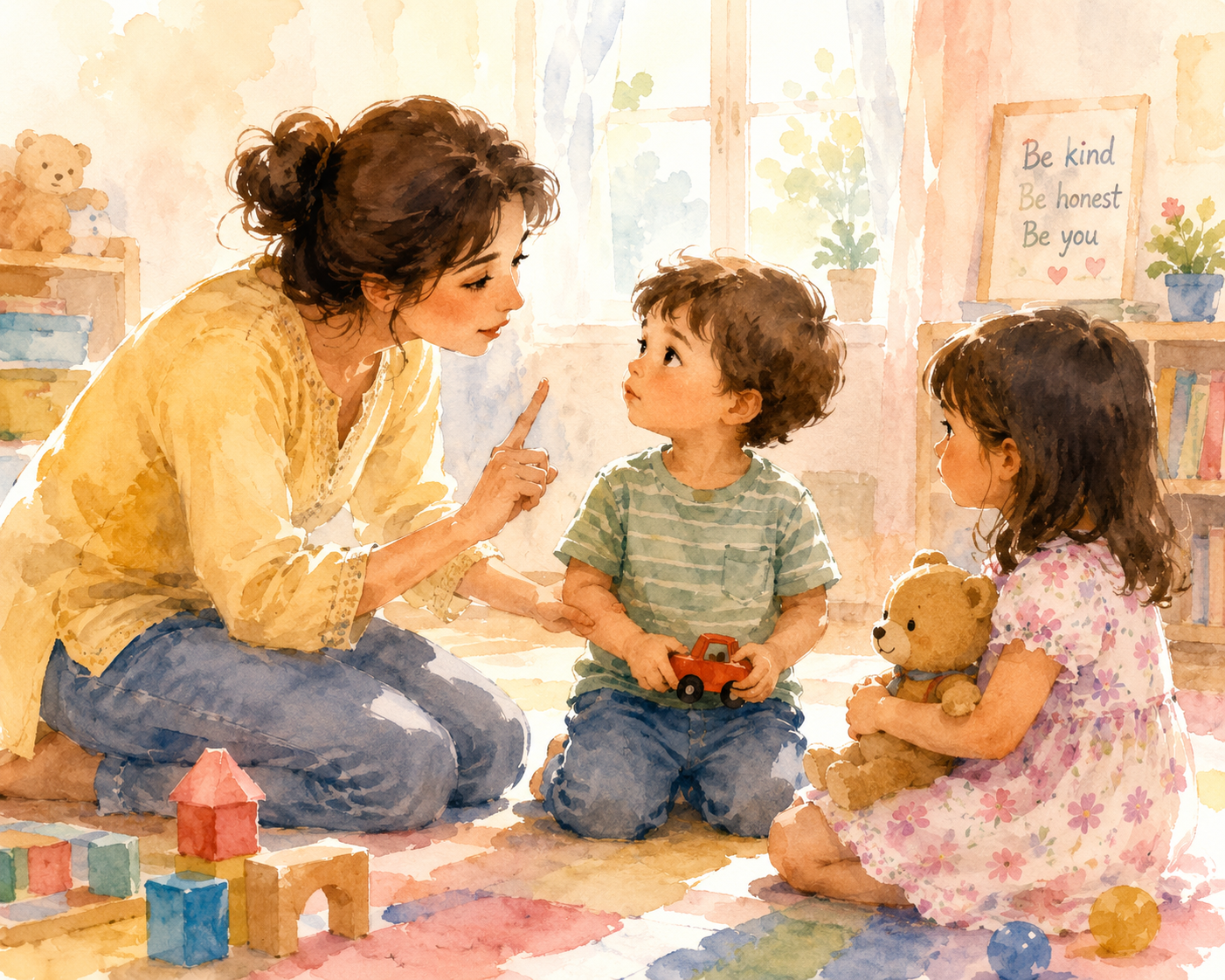
Everything in this article applies to children too, with one beautiful difference. Children don't only form habits from their own experiences. They form them by watching us.
Children learn habits by copying. A child who sees a parent reading will often reach for a book. A child whose parents put phones away at dinner learns that mealtimes are for conversation. A child who hears a parent say, "I'm feeling frustrated, so I'm going to take a deep breath," learns a habit of calm. Of all the ways we teach our children, our own daily habits may be the most powerful, precisely because we are not trying to teach at all.
Routines are habits that make children feel safe. For children, predictable daily routines are more than convenient. They create a sense of security: children know what comes next, which reduces anxiety and power struggles.
The research on bedtime routines is especially striking. In a study of more than 10,000 mothers across 14 countries, the psychologist Jodi Mindell and her colleagues found that young children with a consistent bedtime routine went to bed earlier, fell asleep faster, woke less during the night and slept longer. Children who had a bedtime routine every night slept, on average, more than an hour longer than those who never did. The effect was "dose-dependent": the more nights a week the routine happened, the better children slept. And in a separate study, introducing a simple, consistent routine improved young children's sleep within just the first three nights.
A simple bedtime routine might look like this: bath, pyjamas, brushing teeth, one story, a cuddle, lights out. The magic is not in the particular steps. It is in the same gentle steps, in the same order, most nights of the week.
Start tiny with children, too. Instead of demanding a spotless bedroom, begin with "put three toys back in the basket." Instead of an hour of reading, begin with one page together at bedtime. Instead of a big list of chores, begin with one small, regular job that is truly theirs, such as watering a plant or setting the spoons on the table.
Make routines visible for young children. A simple picture chart showing the morning or bedtime routine lets children follow along independently. Better still, let them help design it. Children are far more committed to routines they helped create.
Be thoughtful with rewards. Stickers and small rewards can help get a new routine started. But research on motivation suggests that rewarding children for things they already enjoy can sometimes reduce their natural interest. Over time, let the good feeling of the habit itself, and your warm, specific praise ("You remembered all by yourself!"), take the place of prizes.
Build a few family habits. Some of the most precious habits belong to the whole family: a shared meal a few evenings a week, an evening walk, each person sharing one good thing from their day at dinner, a Sunday morning story. These small rituals become the threads that hold a family together, and often the memories children carry for the rest of their lives.
❦
Small Habits That Quietly Change Lives
Here are a few tiny habits worth considering, for yourself and your family. Choose just one to begin.
|
Tiny habit |
Anchor it to… |
Why it matters |
|
Read two pages |
Your morning tea |
Grows a reading life, and children often follow |
|
One deep breath before responding |
The moment you feel irritation rising |
Builds calm, and models self-control for children |
|
Ten minutes of undivided attention |
Your child coming home from school |
Deepens connection and trust |
|
One good thing about the day |
Dinner or bedtime |
Encourages gratitude and warm family conversation |
|
A ten-minute walk |
After lunch or after school drop-off |
Lifts mood and energy |
|
Phone charges outside the bedroom |
Brushing your teeth at night |
Protects sleep for the whole family |
|
Put three things back in their place |
Coming home each evening |
Keeps a calmer, tidier home with little effort |
|
A glass of water |
Waking up |
A simple, easy first win of the day |
❦
When You Slip, Be Kind to Yourself
There will be days, and perhaps weeks, when your habits fall apart. A child is ill. A deadline looms. A family wedding swallows a whole month. This is not failure. It is life.
What matters most is how we respond. It is tempting to criticise ourselves harshly: I never stick to anything. What's the point? But research suggests that harsh self-criticism often makes us less likely to try again. Self-compassion, treating ourselves with the understanding we would offer a friend, tends to help people take responsibility for mistakes and try to improve.
So when you slip, speak to yourself gently. That's okay. Life got busy. I'll begin again tomorrow, with just two pages. Remember what the research found: a missed day does not undo your progress. Returning is the habit that matters most.
And when your children slip, offer them the same grace. Their habits, like ours, grow slowly, with many stumbles along the way.
❦
Drop by Drop
Go back, for a moment, to Meenal in her kitchen, the tea brewing, a book open on the counter, and a small boy reading quietly beside her.
Nothing about that scene is dramatic. No one made a grand announcement. No life was transformed overnight. Just two pages, most mornings, for a year.
And yet something profound had happened. A woman had become a reader again. A child had quietly learned that books are a part of everyday life. A small, ordinary moment had become a shared ritual, the kind a child remembers long after he has grown.
This is the quiet power of small habits. They do not demand that we become someone else overnight. They ask only that we begin, exactly where we are, exactly as we are, with something small enough to do today.
Drop by drop, an ocean is formed.
"Begin small. Begin today. And trust the quiet work of time."