{Why the feelings we rush to fix are usually the ones we most need to feel.}
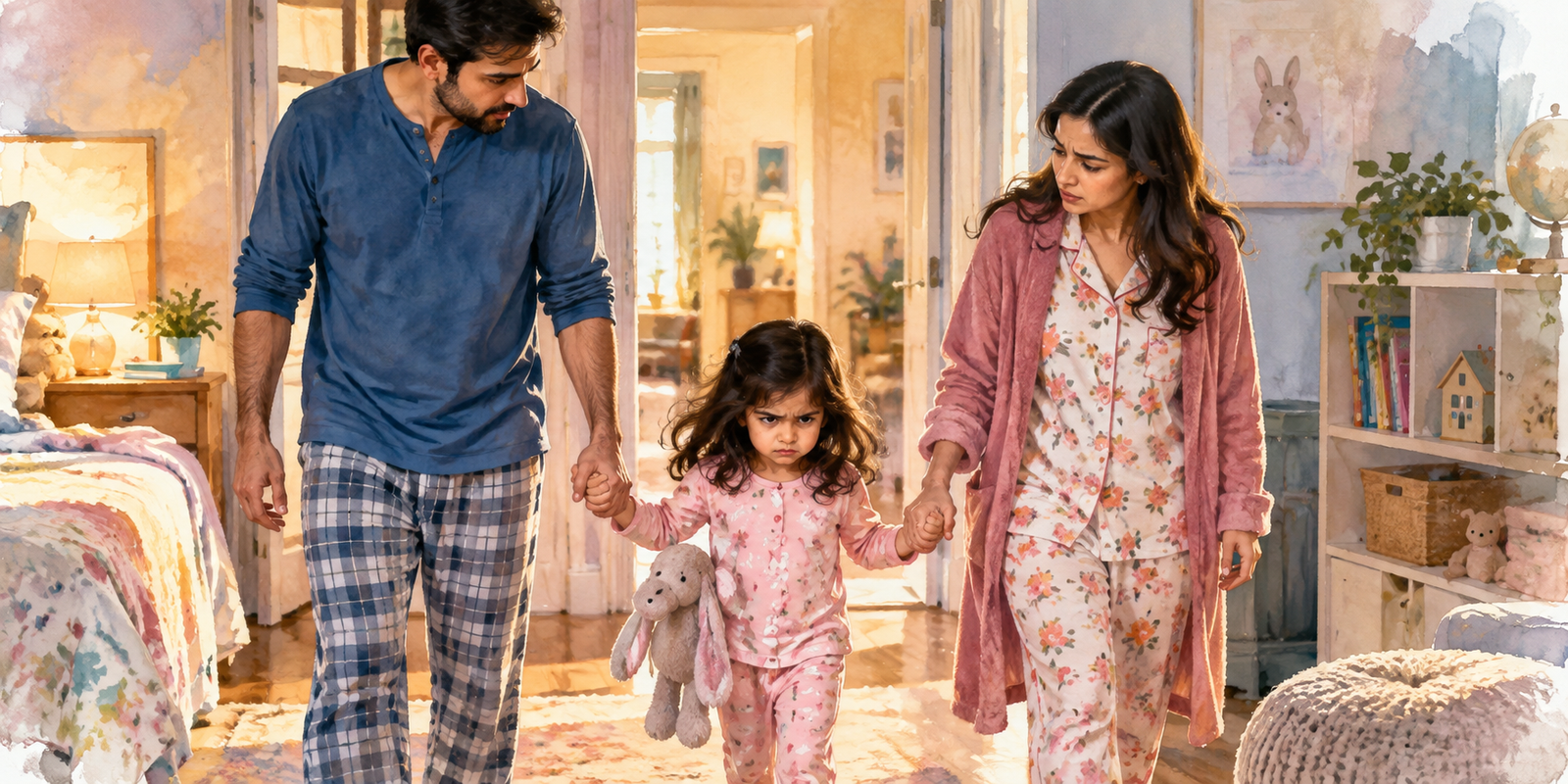
For two years, Neha had slept on the floor of her daughter's bedroom.
It had started innocently. Aanya, then six, became frightened of the dark after a scary film at a cousin's house. She cried. Neha lay down beside her until she fell asleep. It seemed like the kindest thing in the world.
Then it became every night. Then the cot became a mattress on the floor. Then Aanya couldn't fall asleep unless she could reach out and touch her mother's hand.
Aanya is eight now. She is frightened of more things than she used to be, not fewer.
And Neha, lying in the dark with her back aching, has begun to wonder something that fills her with guilt even as she thinks it.
What if all this comfort has made things worse?
The Thing Nobody Told Us
There is a skill that sits underneath almost every other skill in life. It has no glamour, no certificate, no course. Most of us were never taught it, and many of us are quietly terrible at it.
It is the ability to feel something unpleasant, and not immediately do something about it.
To be bored and not reach for a phone. To be anxious and not cancel. To watch your child struggle and not step in. To feel angry and not say the sentence. To sit in a silence that is uncomfortable and let it stay uncomfortable.
We call this many things: patience, tolerance, resilience, grit. But underneath all of them is one plain ability. Staying.
And here is the part that changes everything. Almost every problem that grows over time, in us and in our children, grows because we could not stay.
First, What This Is Not
Let's clear away two misunderstandings, because they matter.
This is not about suffering for the sake of it. Nobody benefits from pointless pain. If a situation is genuinely harmful, leave it. Sitting with discomfort is about the ordinary, unpleasant, non-dangerous feelings that life is full of. Nervousness. Boredom. Disappointment. Frustration. Awkwardness. Longing.
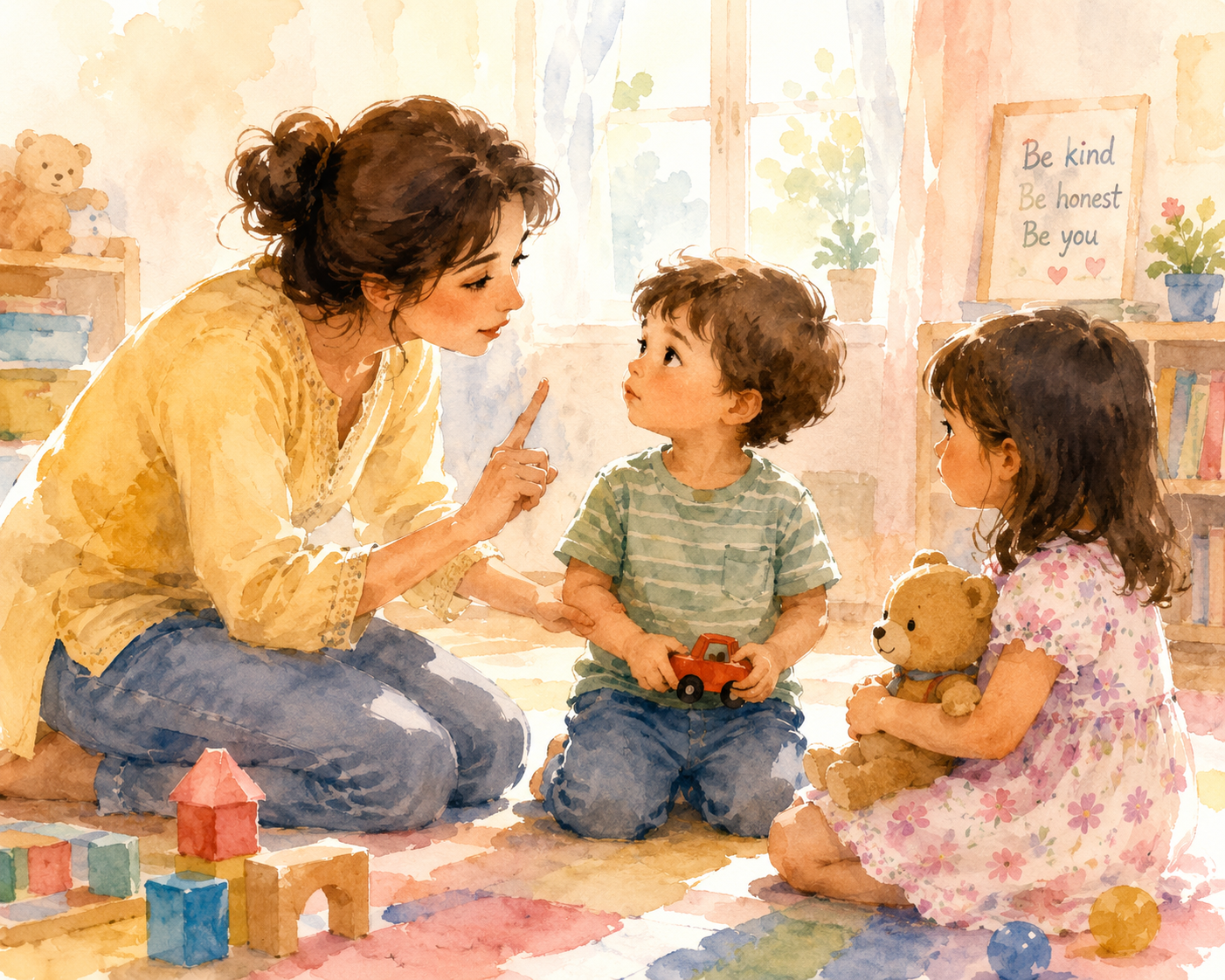
This is not about toughening children up. It is almost the opposite. You do not teach a child to tolerate hard feelings by leaving them alone with them. You teach it by sitting beside them while they feel it, and by not panicking yourself.
Comfort and capability are not enemies. The goal is to be warm and to believe your child can survive being uncomfortable.
Why We Cannot Stay
There is a simple, brutal reason avoidance is so hard to break.
Escaping works. Immediately. Every single time.
Your child is dreading a birthday party. You let her skip it. Within seconds, the crying stops. The relief is instant and total, for both of you.
But look at what has just been learned.
The child's brain has recorded something: That was dangerous, and leaving saved me. The fear has been confirmed, not challenged. And next time, the fear arrives slightly stronger, because now it has evidence.
Your brain has learned something too: When she is upset, I can make it stop. And that relief is powerfully rewarding.
So the loop closes. Fear leads to escape, escape leads to relief, relief makes the fear bigger, and the bigger fear makes escape more necessary.
This is why avoidance is so hard to see as a problem. It never feels like harm. Every single step of it feels like love.
The White Bear
The same thing happens inside our own heads.
In 1987, the psychologist Daniel Wegner ran an experiment so simple it has become famous. He asked people to say whatever came into their minds for five minutes, with one instruction: do not think about a white bear. If a white bear came to mind, ring a bell.
They rang the bell, on average, more than once a minute.
Then he asked them to deliberately think about a white bear. Now they thought about it even more often than people who had never been told to suppress it in the first place.
Wegner called it the rebound effect, and it has been found again and again. Pushing a thought away doesn't remove it. It keeps it warm and close and ready to spring back.
Try it yourself. Tell yourself not to feel nervous before an important conversation, and watch what happens.
What we resist, we hold on to.
What Happens If You Just Stay
So what happens if you don't escape? If you simply feel the feeling and let it be there?
Something surprisingly ordinary. It passes.
You have probably heard the claim that an emotion lasts only ninety seconds if you don't feed it. That number is repeated everywhere, and honestly, the science behind it is thinner than the confidence with which it's stated.
But the broader finding is solid and well-established. When people stay in contact with something that frightens them, instead of fleeing, the fear comes down on its own. Not because they fought it. Because bodies cannot stay at high alarm indefinitely. This gradual settling is the basis of the most effective treatments for anxiety in the world.
Every escape steals that lesson. Leave at the peak, and you never find out that the wave breaks.
Naming Is Not the Same as Fixing
There is one thing you can do while you stay, and it turns out to be surprisingly powerful.
Put it into words.
In a study at UCLA, the psychologist Matthew Lieberman scanned people's brains while they looked at distressing images. When participants simply labelled what they saw — angry, afraid — the amygdala, the brain's alarm system, became less active. At the same time, a region of the prefrontal cortex lit up, the part that handles thinking in words about feelings.
Lieberman described it as hitting the brakes on your emotional reactions.
Notice what naming is not. It isn't solving. It isn't reassuring. It isn't arguing with the feeling. It is simply saying what is true: I am nervous. This is disappointment. I feel angry right now.
For children, this is exactly why "You're really scared of the dark" helps far more than "There's nothing to be scared of." One names the experience. The other argues with it, and nobody has ever been argued out of a feeling.
The Research Every Parent Should Know
Now we come to the part that I think will matter most to you, and it takes us back to Neha on the bedroom floor.
Psychologists have a name for what she was doing: family accommodation. It means the changes parents make to their own behaviour to reduce their child's distress.
Almost every parent of an anxious child does it. Most of us don't know it has a name.
Here is what it looks like.
|
What accommodation looks like |
What the child learns |
|
Sleeping in their room every night |
I cannot sleep alone |
|
Answering the same worry twenty times |
I need you to make the worry stop |
|
Speaking for them at shops or with relatives |
I cannot speak for myself |
|
Letting them skip the party, the class, the trip |
That place was genuinely dangerous |
|
Doing the homework task they're afraid to attempt |
I cannot do hard things |
|
Rearranging family plans around their fears |
My fear is in charge of this family |
Research on accommodation finds a consistent and painful pattern. It relieves distress in the short term. But over time it is associated with more severe symptoms, greater difficulty functioning, and poorer response to treatment.
The kindness works. And it works against you.
The Study That Changes How We See This
Here is where it gets genuinely hopeful.
At the Yale Child Study Center, Dr Eli Lebowitz developed a treatment called SPACE, which stands for Supportive Parenting for Anxious Childhood Emotions. What makes it unusual is that the child is not treated at all. Only the parents come.
Parents learn two things. How to reduce their accommodation, gradually and with warning. And how to replace it with what Lebowitz calls supportive statements.
In a trial of 124 children aged seven to fourteen, families were randomly assigned either to SPACE, where the therapist never worked with the child, or to individual cognitive behavioural therapy, the long-established treatment, where the therapist never worked with the parents.
SPACE worked as well as CBT.
Let that sit for a moment. Children's anxiety improved just as much when only their parents changed what they did.
Which means the way you respond to your child's distress is not a small thing around the edges of their anxiety. It is close to the centre of it.
The Two Halves of a Supportive Response
The heart of the approach is a sentence with two parts, and both parts are essential.
Part one: validation. I know this is really hard for you. I know you're scared.
Part two: confidence. And I know you can handle it.
Most of us do one or the other. Either we validate endlessly, drowning the child in sympathy and fixing, which quietly says you're right, this is too much for you. Or we go straight to confidence with no warmth: don't be silly, just go.
Validation without confidence creates fragility. Confidence without validation feels like abandonment.
Together, they say the only thing a frightened child really needs to hear: Your feeling is real, and you are bigger than it.
Some practical notes on using it.
Say it once, not ten times. Repeating reassurance is itself accommodation. Say your sentence, then stop talking.
Announce changes in advance, kindly. Don't withdraw support overnight. Tell your child: "From Monday, I'm going to sit in the chair instead of on your bed, because I know you can do this." Ambush breeds panic.
Change one thing at a time. Not everything. One.
Expect it to get louder before it gets quieter. When a familiar comfort is removed, distress usually spikes first. This is normal, and it is the hardest moment to hold. It is also the moment everything turns.
Never make it a punishment. Your warmth should go up, not down, while you do this. You are not withdrawing love. You are withdrawing the message that they cannot cope.
But First, You
Here is the truth that sits underneath all of it.
You cannot let your child sit with discomfort if your child's discomfort is unbearable to you.
When Neha lies on that floor, she is not only soothing her daughter. She is soothing herself. The sound of her child crying is intolerable, and the mattress makes it stop.
This is not a failing. It is love wired into the body. But it means the real work often begins with the parent.
So notice what your child's distress does to you. The tightening chest. The urge to fix it immediately. The thought I can't stand this.
Then practise staying with that. Breathe. Name it silently: This is my anxiety, not hers. And remind yourself of the distinction that makes it possible: your job is not to keep your child from feeling bad. Your job is to help them survive feeling bad.
That distinction changes everything.
How to Practise Staying, in Small Ways
You don't have to start with the hardest thing. Discomfort tolerance grows like any other capacity, through small repetitions.
Wait five minutes before fixing. Whether it's your feeling or your child's. Often the wave breaks on its own.
Let boredom happen. Don't rescue a bored child immediately. Boredom is the doorway to imagination, and the ability to sit in it is a life skill.
Let silences stay. In conversations, in arguments, at the dinner table. The urge to fill silence is usually the urge to escape discomfort.
Let them struggle with a hard task for a little longer than is comfortable for you. Offer encouragement, not answers.
Notice the reach. Every time your hand goes to your phone, pause and ask what feeling you were just leaving.
Name it before you act. I'm feeling frustrated. This is disappointment. Then decide what to do, if anything.
Say to your child what you wish someone had said to you. "This is hard, and I'm right here, and you can do hard things."
When Sitting With It Is Not the Answer
Being honest about limits is part of being useful, so let me be clear about three.
Real danger is not discomfort. If a child is being bullied, hurt, or is genuinely unsafe, that is not a feeling to be tolerated. Act.
Some distress needs professional help. If anxiety is stopping your child from going to school, eating, sleeping or seeing friends, or if it has lasted for weeks and is getting worse, please speak to your doctor, a school counsellor or a child psychologist. Anxiety in children responds very well to treatment. Seeking help is not failing at this.
And if your child talks about wanting to hurt themselves, do not wait. Get help immediately.
Sitting with discomfort is a skill for ordinary hard feelings. It is never a reason to leave a child alone with something too big for them.
Back on the Bedroom Floor
Let us return to Neha.
Here is what she did, over about six weeks.
She told Aanya on a Sunday, calmly, that things would change on Monday. From Monday she would sit in the chair by the door, not on the mattress. She would stay until Aanya was sleepy, and then she would go.
Monday was terrible. So was Tuesday.
Each night Neha said the same two things, once, and then stopped talking. "I know the dark feels scary to you. And I know you can do this."
By the second week, Aanya cried for a few minutes rather than an hour. By the fourth, Neha was sitting outside the door. By the sixth, she was saying goodnight from the doorway.
But the thing Neha noticed was not really about bedtime.
Aanya started putting her own hand up in class. She went to a birthday party. One evening she ordered her own ice cream from the man at the counter, something she had never done.
Because that is what actually happened in those six weeks. Aanya did not learn to sleep alone.
She learned that she could feel something frightening, and survive it, and still be there in the morning.
That is the lesson underneath every other lesson. And once a child has it, they carry it into every room they ever walk into.
"You cannot make the hard feelings smaller. You can only help a child discover they are bigger than the feelings."
This article is for general guidance and is not a substitute for professional advice. If you are worried about your child's anxiety or wellbeing, please speak to a qualified professional.