{Beyond the panic and the permission-giving: what we know, what we don't, and what actually matters.}
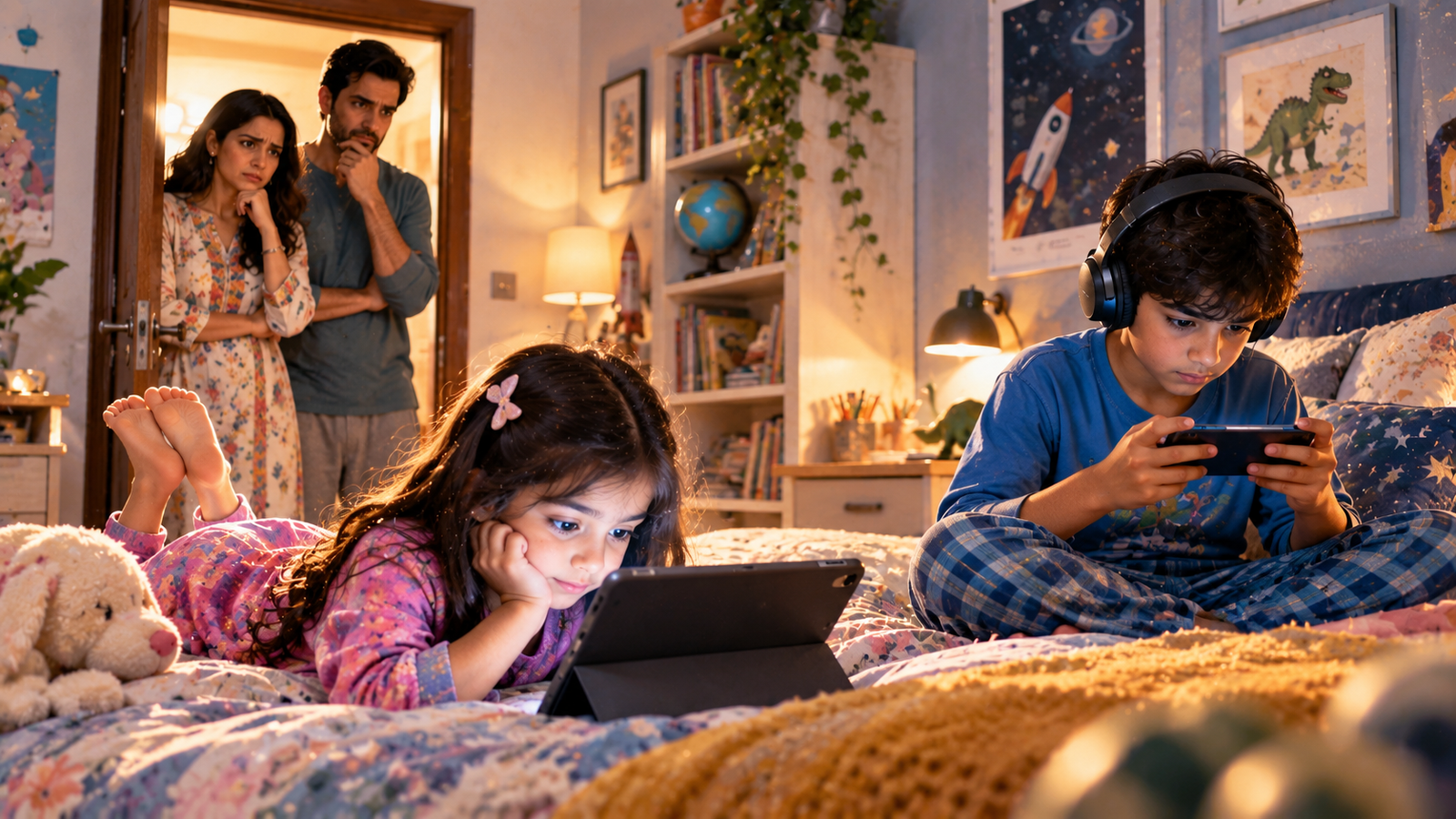
It is half past eleven at night. The children are finally asleep. Aditi is lying in bed with her phone, doing what millions of parents do at this hour. She is searching for the truth about screen time.
The first headline says screens are rewiring her son's brain.
The second says screen-time panic is nonsense.
The third says one hour a day, maximum.
The fourth says hour limits are meaningless.
She puts the phone down. She is more confused than when she picked it up. And she adds one more item to the long list of things she is probably getting wrong.
If you have ever been Aditi, this article is for you. Not to frighten you. Not to excuse everything. Just to tell you, as simply and honestly as I can, what the research actually says.
Why the Headlines Keep Fighting
There are three reasons the advice never agrees with itself.
First: "screen time" isn't really one thing.
Think about what that phrase includes. A video call with Nani. Homework. A ten-year-old learning to animate. Two friends building a world together in Minecraft. A toddler watching cartoons alone for three hours. An eleven-year-old scrolling through videos designed by engineers to be impossible to stop watching.
These are not the same activity. Counting them all as "hours of screen time" is like measuring your diet by "hours of eating" without ever asking what was on the plate.
Second: the same data can tell many different stories.
In 2019, two Oxford researchers, Amy Orben and Andrew Przybylski, looked at data from more than 350,000 young people. They found something remarkable. There were over 600 million possible ways to analyse that data, and depending on which choices a researcher made, they could show that screens were harmful, helpful, or made no difference at all.
So they measured all of them. Their answer: screen use explained at most 0.4% of how well teenagers were doing.
To put that in perspective, they pointed out that in the same data, eating potatoes had a similar-sized link, and wearing glasses had a slightly worse one.
This doesn't prove screens are harmless. But it does mean any researcher hunting for a scary headline can usually find one.
Third: almost none of it proves cause.
Studies find that children who use screens more also sleep less, or concentrate less, or feel lower. But which came first?
A lonely child may retreat into a phone. A family under strain may leave the television on. The screen might be the cause. It might be the symptom. It might be neither.
When a headline says screens "cause" something, it is almost always claiming more than the study can show.
What the Evidence Really Does Support
Now the useful part. Underneath all the noise, some findings are solid and worth acting on.
Notice something about them. Almost all are about young children. And almost all are about what screens replace, rather than screens themselves.
1. Small children learn from people, not screens
This is one of the most reliable findings in child psychology. It even has a name: the video deficit.
Study after study shows the same thing. A baby or toddler learns a new word far better from a real person in the room than from the exact same lesson on a screen. The effect shows up around six to twelve months, is strongest in the second year, and starts fading in the third.
Why? Because a small child's brain is built for conversation.
A real person follows your child's eyes. Responds to her babble. Waits when she looks away. Names the thing she is actually reaching for. A screen can't do any of that, however bright and clever it is.
At this age, learning is a conversation, not a broadcast.
What about video calls? They are a little different, and some studies show children do learn better when a person on screen genuinely responds to them. But it isn't magic. In one study of 176 toddlers, an on-screen adult responding in real time still wasn't enough to teach a new word. The children needed a grown-up in the room, linking the screen to the world around them.
So: a call with grandparents is lovely. But no app teaches a baby as well as you do. And if a screen is on, sitting beside your child and talking about it turns a broadcast back into a conversation.
2. Screens quietly steal your child's conversations
This is, I think, the single most useful thing a parent can know. And it is very new.
In 2024, researchers in Australia led by Dr Mary Brushe did something clever. Instead of asking parents to guess their child's screen time, they fitted 220 families with small recorders that captured the real sound of the home across a sixteen-hour day. They did this again and again, from when the children were one until they turned three.
Here is what they found. At age three, every single extra minute of screen time meant roughly seven fewer adult words spoken to the child, five fewer sounds from the child, and one fewer back-and-forth exchange.
The children in the study averaged about 172 minutes of screen time a day. On those numbers, a child could be missing more than a thousand adult words every day.
Researchers call this technoference. Technology quietly getting in the way of the talk that builds a child's mind.
And look at what it really means. The harm isn't some mysterious effect of pixels on brain cells. It is much simpler, and much sadder. The screen fills the room with sound, and the talking stops.
3. Sleep is where the evidence is clearest
Of all the worries about screens, this one has the strongest backing, at every age.
Reviews of the research keep finding the same pattern. Screens in the evening, and especially devices in the bedroom, mean later bedtimes, longer to fall asleep, and less sleep overall.
The reasons aren't mysterious. Light in the evening confuses the body's sleep signals. Exciting content leaves the mind buzzing. And a phone by the bed is simply always there.
Sleep matters enormously. A tired child is more irritable, less able to concentrate, quicker to melt down and more prone to low mood. Many of the problems we blame on screens may travel through this one simple route.
If you change only one thing after reading this article, make it this: keep devices out of bedrooms at night, for children and teenagers. It is the single most evidence-backed screen rule there is.
4. What screens replace matters more than screens
Researchers call this the displacement idea, and it changes the whole question.
A day has a fixed number of hours. Every hour on a screen is an hour not spent sleeping, running about, reading, playing, talking, or being pleasantly bored. Much of the harm we blame on screens is really the absence of those things.
This is good news, because it gives you a far better question than "how many hours?"
Ask instead: what is this screen time crowding out?
If your child sleeps well, moves her body, talks with her family, reads and plays with friends, the screen time that remains is far less worrying than the same hours in a child doing none of those things.
Where Nobody Really Knows
An honest article has to say where the evidence doesn't settle things. And on the biggest question of all, it doesn't.
Is social media causing the rise in teenage anxiety and depression?
The psychologist Jonathan Haidt says yes, forcefully, in his bestselling book The Anxious Generation. He points to the timing. Teenage distress began climbing in the early 2010s, just as smartphones and social media became universal.
Many respected researchers disagree. Not with his concern, but with his certainty. Writing in Nature, the psychologist Candice Odgers argued the evidence doesn't support his central claim, and warned that blaming social media may distract us from other causes. The Oxford work described earlier found the measurable effects tiny. Critics also note that the timing is suggestive, not proof, and that teenage distress has risen in some countries but not others, despite similar phone use.
So what should a parent do with an argument that isn't finished?
Not panic, and not shrug. A few things are clear even now.
Effects differ hugely from child to child. An average across thousands of teenagers can hide real harm to some and real benefit to others.
What a teenager does online matters more than how long. Endless scrolling and comparing yourself to strangers is nothing like messaging a close friend or making something creative.
Sleep is a real and well-proven route to harm.
And a young person already struggling with anxiety, low mood or how they feel about their body is likely to be more vulnerable to what social media feeds them.
Uncertainty about the average is not a reason to ignore the child in front of you.
The Big Shift: From the Clock to the Context
Here is something most parenting advice hasn't caught up with yet.
For ten years, the world's most-quoted screen rules were the American Academy of Pediatrics guidelines from 2016, built largely on research from the age of the family television.
In January 2026, the AAP released new guidance. And it changed direction.
Instead of leading with a number of hours, it leads with two ideas. First, that a child's media life sits inside circles of influence: the child at the centre, then family and school, then culture, law and the technology industry itself. Second, that many apps are deliberately built to hold attention through endless scrolling and autoplay, and the companies who design them carry responsibility too.
Dr Jenny Radesky, who chaired the AAP council while the policy was written, puts it simply. Media use doesn't happen in a vacuum, and relationships sit right at the centre of it. Young people with strong, supportive relationships, both offline and online, tend to use media in healthier ways.
To make this usable, the AAP offers a framework called the 5 Cs of Media Use. It is the most practical thing I have found for parents, because it replaces one anxious question with five good ones.
Child. Who is this child? A sensitive seven-year-old, a shy teenager and a confident twelve-year-old need different things.
Content. What are they actually watching or doing? A documentary, a drawing app, a violent game and an endless video feed are completely different experiences.
Calm. Are screens becoming the main way your child settles down or falls asleep? A child who can only calm down with a device hasn't yet learned to calm down.
Crowding Out. What is media pushing aside? Sleep, movement, family time, play, homework, friends. Protect these, and the rest usually sorts itself out.
Communication. Do you talk with your child about their digital life, without judging? Conversation, not surveillance, is what builds judgement that lasts.
What the Guidelines Actually Say
Time limits still matter, especially for young children, where the evidence is strongest. Here is what the main bodies advise, including the Indian Academy of Pediatrics, whose guidance is written with Indian families in mind.
|
Age |
WHO (under-5s) |
Indian Academy of Pediatrics |
|
Under 2 years |
No sedentary screen time (video calls with family are generally fine) |
No screens of any type |
|
2 to 4 years |
No more than 1 hour a day; less is better |
Max 1 hour of supervised screen time (24–59 months) |
|
5 to 10 years |
— |
Less than 2 hours a day |
|
11 years and above |
— |
Agreed family limits; protect sleep, study and activity |
The AAP's newer guidance keeps firm limits for the youngest children. But for children of about six and older, it asks families to build a shared plan around sleep, activity, schoolwork and face-to-face time, rather than chasing one magic number.
Treat all of this as a sensible floor, not a scoreboard. A family that sometimes goes over hasn't failed. A family that stays under but never talks to each other has missed the point.
What Actually Helps
Protect the essentials first. Decide what your child's day must contain: enough sleep, an hour of moving about, time outdoors, a meal together, homework, free play. Screens live in whatever is left. This one decision does most of the work.
Make some places and times screen-free. Bedrooms at night. Mealtimes. The hour before bed. These are far easier to hold than a running clock, and they protect exactly what needs protecting.
Watch together when you can. Ask questions. Pause and wonder aloud. Link what is on the screen to your child's own life. A shared screen is a social experience. A lonely one rarely is.
Choose content the way you choose food. Slow, gentle, well-made programmes ask something very different of a child's brain than loud, fast, endlessly autoplaying feeds. And turn off autoplay wherever you can. One small setting removes a lot of pull.
Teach children to notice how screens make them feel. Older children can learn a powerful question: do I feel better or worse after this? That habit will serve them long after your rules have ended.
Talk instead of policing. Try: "What are you loving watching right now?" "What makes you finally stop scrolling?" "Has anything online ever made you uncomfortable?" Children who feel they can talk to you are the ones who will come to you when something goes wrong.
Careful with the soother. It is completely human to hand over a phone in a restaurant or a waiting room. Just don't let it become the only way your child learns to handle boredom or big feelings. Keep a small bag of alternatives: a notebook, a puzzle, a story invented together.
Look at your own phone. This is the uncomfortable one. Children absorb our habits. They notice when our eyes are on a screen instead of on them. A parent who puts the phone in a drawer at dinner teaches more than any rule ever could.
And Please, Put Down the Guilt
If you are reading this and quietly listing everything you have done wrong, please stop.
Nothing in this research says a child who watched cartoons through a hard week has been damaged. Nothing says a working parent who needed twenty quiet minutes has failed. This evidence is about patterns over years, not single afternoons.
Screens used thoughtfully, in a home full of talk and sleep and play and love, are simply one more part of modern childhood.
There is also a real cost to parental anxiety itself. A guilty, frightened parent is a less present parent. The research doesn't ask you to be perfect. It asks you to protect a handful of things that genuinely matter: sleep, talk, movement, play, and your own attention.
When it's worth getting help. Sometimes screen use tips into something a family rule can't fix. Watch for screen use that keeps harming sleep or school, a child who becomes intensely distressed when devices are taken away, withdrawal from friends and activities she used to love, or any sign of bullying, harmful content or unsafe contact online.
If you see these, talk to your child's doctor, a school counsellor or a mental health professional. These problems are solvable, and the earlier you deal with them, the easier they are.
The Question Worth Asking
Let us go back to Aditi, awake at half past eleven, searching for a number.
There isn't one. Not really.
The honest answer from the research is messier than a rule, and far more useful. Screens matter most through what they take the place of.
So the question is not "how many hours was my child on a screen today?"
It is this. Did she sleep well? Did she move her body? Did we talk, really talk, about something? Did she play, invent, get bored, make something? Did she see my face more than the back of my phone?
Protect those things, and screens will find their proper size. They will become what they should have been all along. One part of a full and human childhood, rather than the thing that quietly replaced it.
"Guard the conversation, the sleep and the play. The rest will look after itself."
This article summarises current research for general guidance and is not a substitute for professional advice. If you have concerns about your child's development, sleep or wellbeing, please speak to a qualified healthcare professional.