{The bedtime ritual we gave up too soon, and what happens when we pick it up again.}
The house is quiet in a way it never used to be.
Rohan is fourteen. He comes home, says something that might be "fine", eats, and disappears behind a door. His father, Sameer, passes that door several times an evening and never quite knows how to knock.
They used to talk constantly. There was a time when Sameer couldn't get through a single chapter of a bedtime story without being interrupted by questions. And then, somewhere around Rohan's ninth birthday, the stories stopped. Not with any decision. Rohan could read by himself now. It just seemed like the natural end of something.
What Sameer doesn't know, standing outside that door, is that the thing he misses most is something he could simply start again.
Not the talking. The reading.
The Statistic That Should Stop Us
Every couple of years, Scholastic surveys thousands of families about reading. Buried in that research is a finding that quietly breaks your heart.
Reading aloud peaks around age five, and then falls away fast. By ages six to eight, only about a third of children are still read to regularly. By nine to eleven, it's one in six. And when parents are asked why they stopped, the most common answer is simple and sensible: my child can read by himself now.
But the researchers also asked the children.
Four in ten children who are no longer read aloud to said they wished their parents had continued.
And the reason they gave most often was not about books at all.
It was a special time with my parents.
Read that again. Somewhere in your house, there may be a person who misses this and has never found a way to say so.
Why We Stopped, and Why It Was the Wrong Reason
The logic seems unarguable. A child learns to read, so reading aloud has done its job. You wouldn't keep holding a bicycle that someone can already ride.
But that logic assumes reading aloud was only ever a teaching tool. A ladder to independent reading, to be pulled away once they're up.
It was never only that.
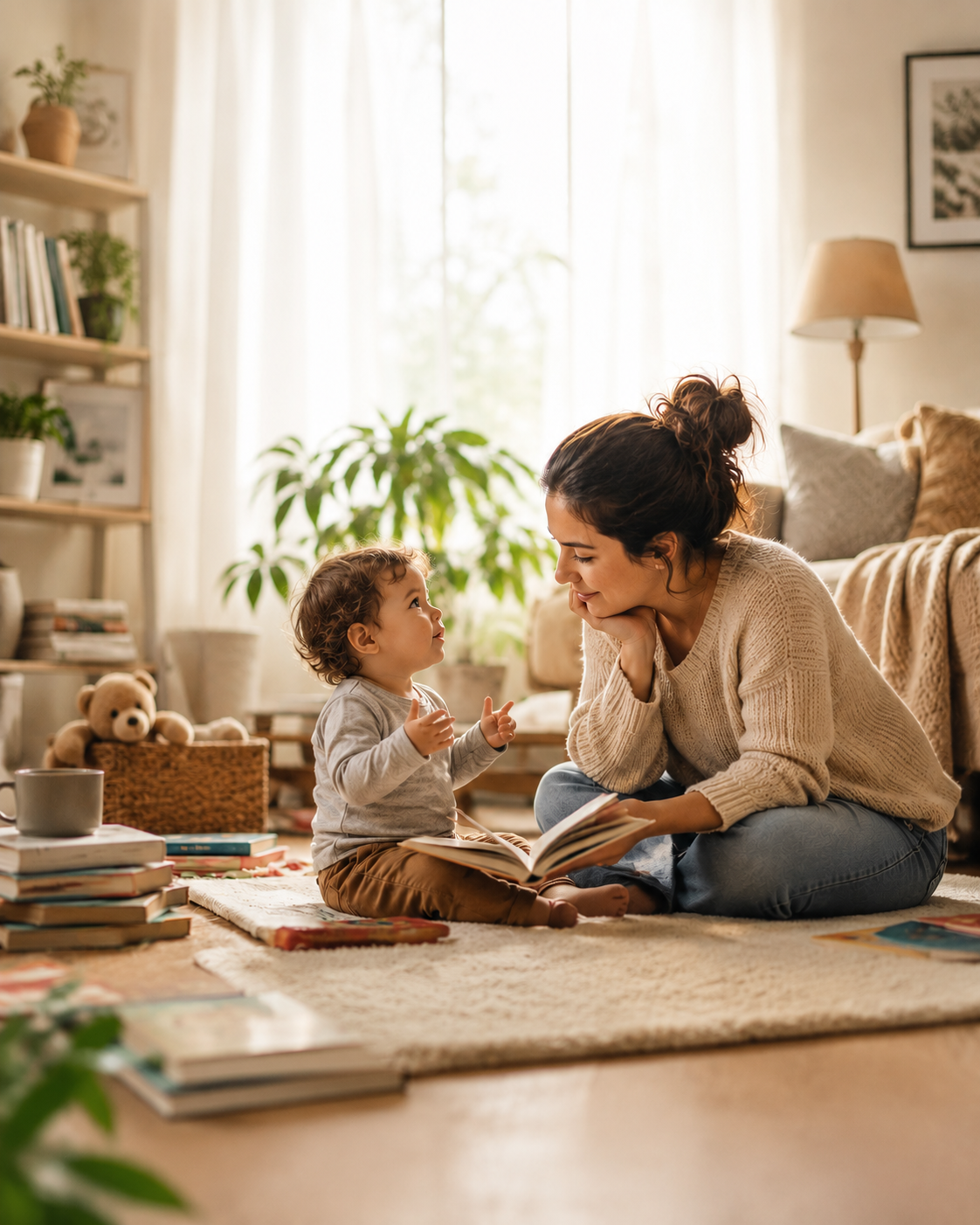
Reading aloud was also a nightly promise that someone would sit beside you. A time when the day's arguments were set aside. A way of sharing a world without having to explain yourself.
None of those things become less necessary at fourteen. If anything, they become harder to find.
Their Ears Are Still Ahead of Their Eyes
There is an old and rather wonderful finding in reading research.
For most of childhood, a child can understand far more complicated language by hearing it than by reading it themselves. Decoding words on a page takes effort, and that effort uses up mental room that could have gone to meaning. Listening is easier, so the listener can follow bigger ideas, longer sentences, richer vocabulary.
Classic research by Thomas Sticht suggested the two abilities don't level out until somewhere around seventh or eighth grade.
To be honest about the evidence, a more recent study found the opposite pattern in today's students, with reading scores ahead of listening scores by grade four. The picture is not as settled as it is often presented.
But something else is very well established, and it matters even more here.
In a large study following over 500 children, researchers measured what actually explains a child's reading comprehension at different ages. In second grade, the ability to recognise words explained a great deal. By eighth grade, it explained almost nothing at all, around two percent.
By adolescence, in other words, reading comprehension is basically language comprehension. Understanding what you read is no longer about decoding. It's about vocabulary, background knowledge, following complicated sentences, holding an argument in your head.
And those are exactly the things that grow when someone reads good writing aloud to you.
This is why reading aloud has no expiry date. You are not helping a teenager sound out words. You are stretching the language they think in.
The Reading Years Are Quietly Collapsing
There's another reason this matters now more than it did for our generation.
In the United States, where the tracking is most detailed, the share of thirteen-year-olds who read for fun almost every day has fallen to about 14%, down from 27% a little over a decade ago. Among nine-year-olds, it has dropped from roughly half to around a third.
By middle school, only about one child in seven reads for pleasure daily.
Every parent knows what has moved into that space. And no lecture about screens has ever created a reader.
But a book read aloud in a warm room, with no test at the end, sometimes does.
What Books Do to Teenagers
Fiction asks something unusual of a reader. To follow a story, you must continually work out what people are thinking, why they did what they did, what they might do next.
Psychologists have a name for that skill: theory of mind, the ability to imagine what is going on inside another person.
Research with adolescents keeps finding a link between reading fiction and this ability. In one large German study following students from Grade 6 to Grade 9, young people who read more fiction in their own time performed better on tests of reading other people's minds, even after accounting for verbal ability and family background.
Studies of teenagers' own accounts of reading say something similar in plainer words. They describe feeling for characters, and then finding that the feeling travels outward, into how they see real people.
This is worth pausing on. Your teenager is in the middle of the hardest social years of their life. Working out who they are, who to trust, what other people are really thinking. A good novel is practice for all of it, and it costs nothing.
The Secret Reason It Works So Well With Teenagers
Here is the part that has nothing to do with literacy, and everything to do with why you should try it.
Teenagers find face-to-face conversation with their parents intense. Eye contact feels like interrogation. How was your day is a question with a wrong answer. So they retreat, and we stand outside doors.
Reading aloud removes all of that.
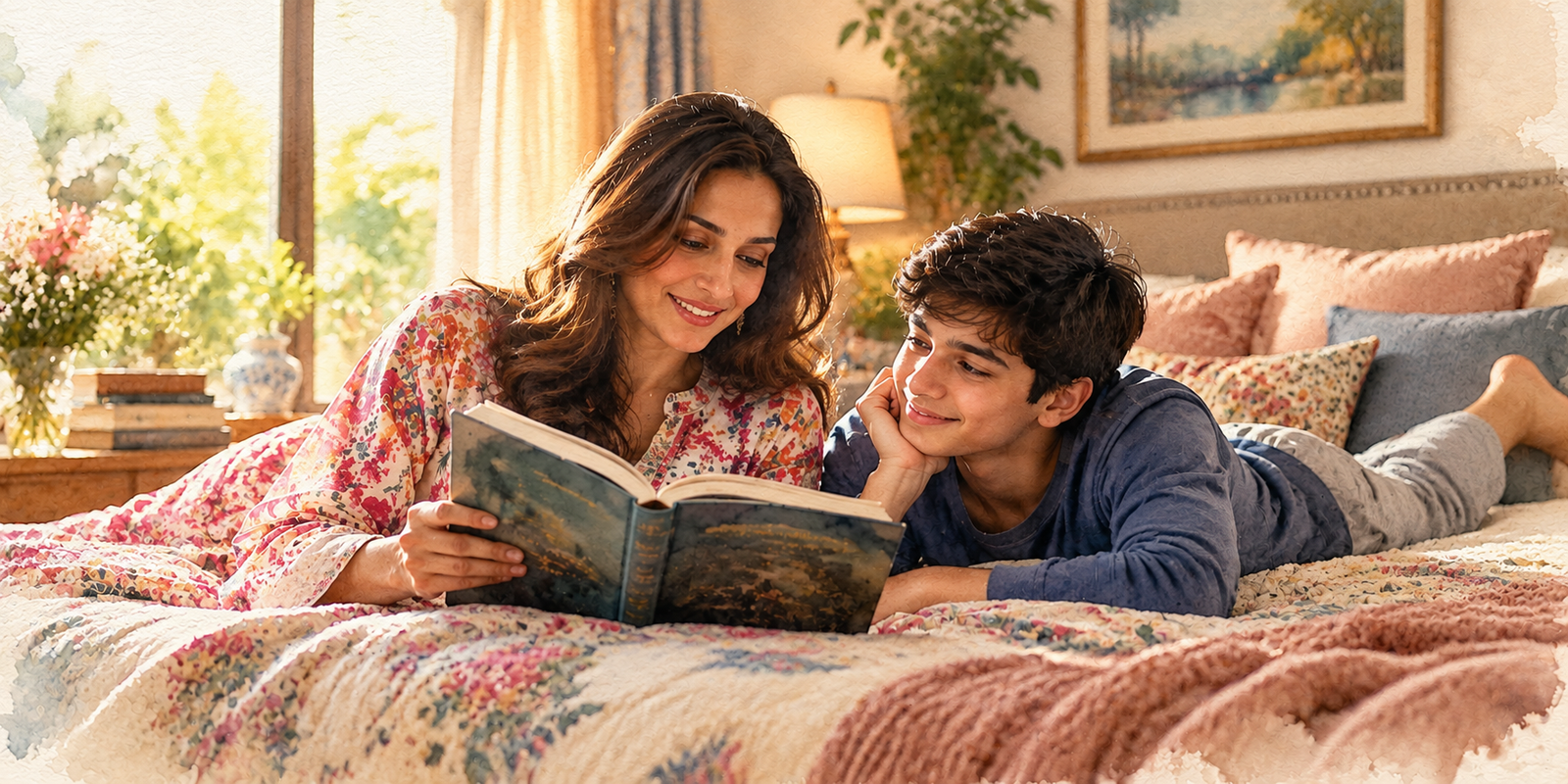
You are side by side, not opposite each other. Nobody is being examined. The book takes the pressure. And because you are both looking at something else, the hardest topics in the world can be discussed in the third person.
A character lies to her parents. A boy is bullied and tells nobody. Someone drinks too much. Someone dies. Someone falls in love with the wrong person.
You can talk about all of it without a single question beginning with "do you ever...". And in the safety of talking about someone else, teenagers often say the truest things about themselves.
It is the same reason so many parents find their children open up in the car. Shoulder to shoulder, eyes elsewhere, no one trapped.
A book is a car you can drive at home.
How to Actually Start With a Fourteen-Year-Old
Let's be realistic. You cannot walk into your teenager's room with a picture book and enthusiasm. Here is what works.
Don't announce it. Please don't say "I read an article and I think we should start reading together." That is instantly a project, and a project can be refused. Just begin.
Lead with something irresistible. Read one page aloud from wherever you are. "Listen to this, it's mad." A newspaper column. A paragraph from a thriller. A poem that's only eight lines long. Then stop. Curiosity does the rest.
Choose a low-pressure moment. In the kitchen while food is cooking. On a long drive. During a power cut. Ten minutes before lights out, if they'll have you.
Start short and stop early. Ten minutes is plenty. Stop while they still want more, not after they've started shifting. This is not about finishing books. It's about them wanting the next evening to come.
Let them choose. This may be the single most important rule. Their book, their genre, even if it's not what you'd pick. A teenager who chooses is a teenager who stays.
Let them do something with their hands. Sketching, folding laundry, building something, even quietly fiddling with a puzzle. Many teenagers listen better when their hands are busy, and it removes the awkwardness of sitting still and being read to.
Read like you mean it. Not dramatically. Just properly. Slow down. Let silences land. If a sentence is beautiful, read it again.
Don't teach. No comprehension questions. No "what do you think the author meant?" No vocabulary quizzes. The moment it becomes a lesson, it's over. Comments are fine. Tests are not.
Take turns, if they want to. Some teenagers love reading aloud themselves. Others will hate the suggestion. Offer once, lightly, and accept the answer.
Expect it to be awkward the first three times. It will be. Then one evening it won't be, and that is the evening it becomes yours.
What to Read Together
Choose things with strong voices and a real pull. Here are directions rather than prescriptions.
|
If you want… |
Try |
|
Something that hooks instantly |
A well-paced thriller or mystery; short chapters, ending each one mid-story |
|
Something funny |
Comic novels or humorous columns — laughter dissolves awkwardness faster than anything |
|
Something that opens hard conversations |
Good young-adult fiction about friendship, loss, identity or belonging |
|
Something short |
Poetry, short stories, or a single long-form article |
|
Something they already love |
Fantasy or science fiction they're deep into; ask them to catch you up first |
|
Something from your own childhood |
A book you loved at their age, offered honestly as *"this one mattered to me"* |
|
Something true |
Well-written non-fiction: science, history, sport, or a life they'd find interesting |
Two practical notes. Pick books slightly harder than they'd read alone, because your voice carries them over the difficult parts. And abandon anything that isn't working, cheerfully and without guilt. A book you both endure teaches the wrong lesson entirely.
If They Say No
Some teenagers will simply not want this, and pushing will end it permanently. There are gentler routes to the same place.
Listen to an audiobook together. On a drive, or while cooking. Shared listening gives you most of the same gifts: the same story, the same conversation, side by side.
Read to the family. If there's a younger sibling, read to them in a common room. Teenagers who would never accept being read to will hover, and then linger, and then sit down.
Read aloud to yourself, where they can hear. Just enjoy something out loud. Let them see an adult who still finds words delicious.
Send them a paragraph. A photo of a page, a line from a poem, forwarded with no comment. It's still reading aloud. It's just in their language.
Try again in six months. A no at fourteen is not a no at fifteen. Illness, exam stress, a hard week, a long journey: these often open the door that was shut.
The Worries, Answered
"Isn't it babyish?" Adults pay to hear authors read their work and listen to audiobooks for hours. Being read to is not childish. It's one of the oldest pleasures we have.
"Won't it make them lazy about reading?" No. Children who are read to tend to read more on their own, not less. And with a teenager, you're not replacing their reading. You're competing with a phone.
"I'm not a good reader." You don't need to be. Your child isn't judging your performance. They're listening to your voice, which is the one voice they have known since before they were born.
"We don't have time." Ten minutes, three nights a week, is enough. That's less time than one episode of anything.
"My English isn't strong enough." Read in whichever language you're most comfortable and expressive in. Hindi, Tamil, Bangla, Marathi, anything. The warmth and the language depth work the same way, and you may give your child something in their mother tongue that school never will.
Back Outside the Door
Let's go back to Sameer, standing in the corridor with his hand not quite knocking.
Here's a version of what could happen next.
He doesn't knock to talk. He knocks with a book, and says, "Listen to this one paragraph, then I'll go." He reads it. He goes.
The next night, Rohan doesn't look up, but he doesn't stop him either.
By the second week, the door is already open when Sameer comes down the corridor.
They'll never talk about it. Rohan will never say this is the best part of my day, because he is fourteen and that is not a thing fourteen-year-olds say. But years from now, when he is asked what he remembers about being that age, this is what will come back. Not the marks. Not the arguments about the phone.
His father's voice, a story, and a room where nothing was being asked of him.
You gave this up because they learned to read. That was never a good enough reason.
Pick up a book tonight. Read one page. See what happens.
"They stopped needing you to read. They never stopped needing you to sit beside them."