{The quiet lessons we learned before we had words, and how we can learn new ones.}
❦
It is 11:40 at night.
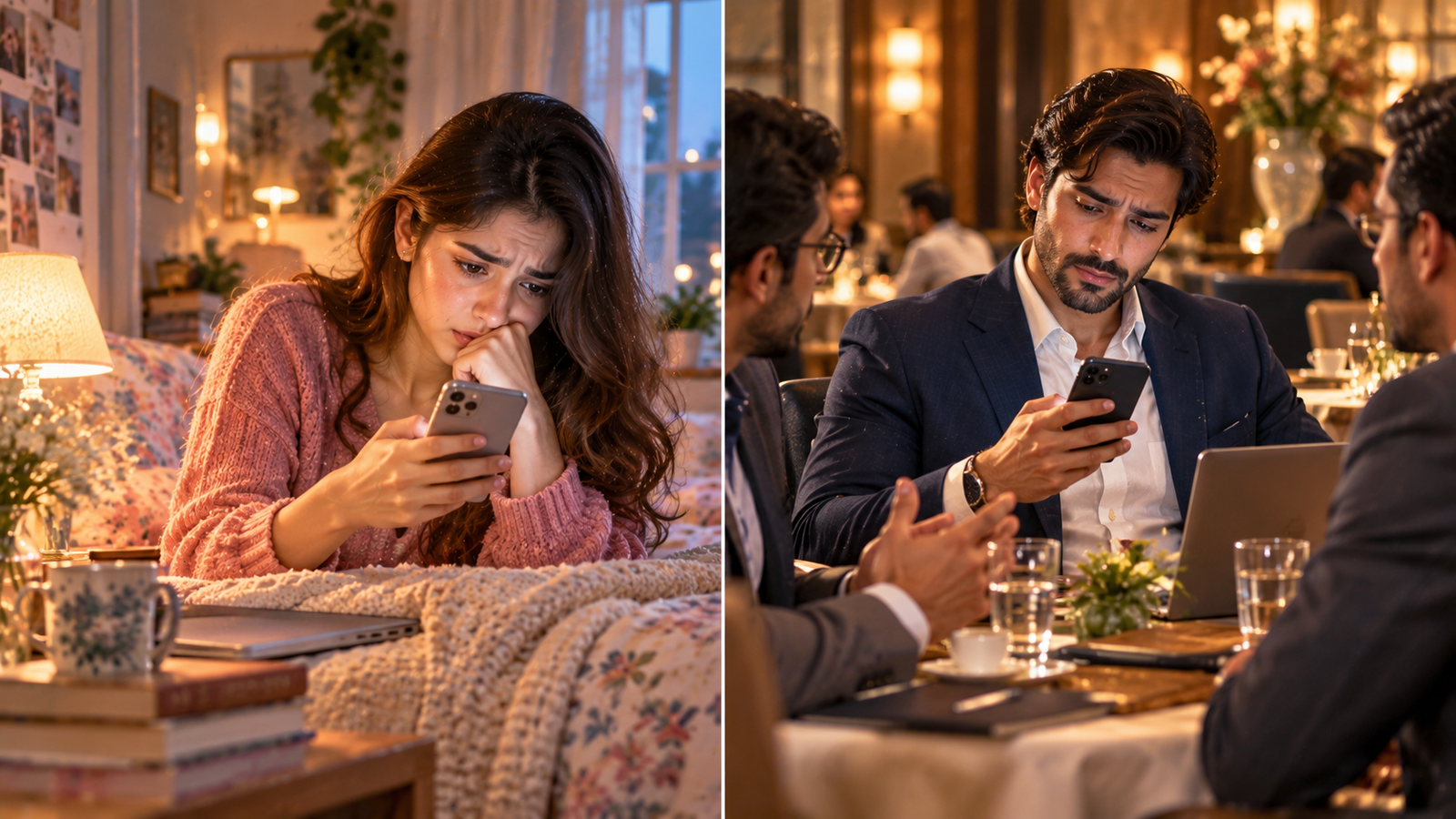
Meera sent a message three hours ago. Just two words: Reached home?
Kabir hasn't replied. The little ticks have turned blue, so she knows he has seen it. And in the silence between those two blue ticks and a reply that isn't coming, Meera's mind begins to write a story. He's annoyed with me. I said something wrong at dinner. He's losing interest. This is how it always begins. By midnight, she has read their entire relationship backwards, searching for the moment it started to fall apart.
Across the city, Kabir is sitting on the edge of his bed. He did see the message. He felt something small tighten in his chest, a faint pressure, as if a door were closing slowly around him. He meant to reply. Instead, he turned the phone face down and told himself he would answer in the morning, when he felt more like himself.
Neither of them is a bad person. Neither of them is being dramatic, or cold, or unfair.
They are simply following maps that were drawn a very long time ago, long before they met each other, long before they could even speak.
❦
The First Language We Ever Learn
Before we learn the alphabet, before we learn our own names, we learn something far more important: whether the world is safe, and whether the people in it will come when we call.
In the middle of the last century, a British psychiatrist named John Bowlby began to notice something about children. He observed that babies are not simply looking for food and warmth. They are biologically wired to seek closeness to a caregiver, because for a small, helpless human being, closeness means survival. When a baby cries and someone comes, the baby learns a lesson. When a baby cries and no one comes, or someone comes sometimes but not always, the baby learns a different one.
His colleague, the psychologist Mary Ainsworth, took this idea further. She watched how infants behaved when their mothers left a room for a few minutes and then returned. Some babies were upset at the separation but settled quickly into their mother's arms when she came back. Some clung desperately and could not be soothed. Others seemed not to care at all, though later research suggested that their bodies were quietly in distress even while their faces stayed calm.
What these babies were showing, in those small reunions, was the beginning of an attachment style: an inner blueprint of love. A set of unspoken beliefs that answer two quiet questions:
Am I worthy of love?
Can I trust the people I love to be there?
Decades later, researchers discovered something remarkable. These blueprints do not stay in the nursery. They grow up with us. They walk with us into our friendships, our marriages, our quarrels and reconciliations. The child who once waited to see if someone would come becomes the adult who waits for a message to be answered.
❦
The Four Core Attachment Styles
Based on our earliest experiences, most of us lean towards one of four broad patterns. As you read them, try to hold them gently. They are not labels to be stamped on your forehead. They are more like weather patterns, describing the climate you grew up in and the way your heart learned to protect itself.
Secure Attachment: "I am worthy of love, and others can generally be trusted."
Securely attached people grew up, for the most part, with caregivers who were responsive. Not perfect, not endlessly patient, not free of bad days. Just present often enough, and warm often enough, that the child came to believe the world was a reasonably safe place.
In love, secure people are comfortable with closeness. They can say "I missed you" without feeling exposed, and "I need a little time to myself" without feeling guilty. They communicate honestly. They can rely on a partner without losing themselves, and they can let a partner rely on them without feeling trapped.
Most importantly, secure people understand that conflict is weather, not the end of the world. An argument is not a verdict on the relationship. It is simply something two people who care about each other will need to walk through, and then walk out of, together.
Anxious-Preoccupied: "If I stop holding on, you might let go."
Many anxiously attached adults grew up with love that was real but unpredictable. A parent who was warm and affectionate one day, distracted or overwhelmed the next. The child could never quite be sure which version of love would arrive, so the child learned to watch closely. To read faces. To cry a little louder, cling a little tighter, and stay alert for the smallest signs of withdrawal.
In adult relationships, this watchfulness becomes a deep fear of abandonment and a constant need for reassurance. Anxious individuals are exquisitely sensitive to shifts in their partner's mood. A shorter reply than usual, a tired tone of voice, a delayed call, and the alarm bells begin to ring. Like Meera at midnight, they may read a whole relationship's future in the length of a single silence.
If this is you, please hear this: you are not "too much." You are not needy by nature. You have a heart that learned, very early, that love had to be earned by paying close attention. That attention was once a survival skill. It simply needs to learn that it can rest now.
Dismissive-Avoidant: "I'm fine on my own. I have to be."
Avoidant adults often grew up in homes where feelings were not welcome guests. Perhaps a caregiver was uncomfortable with tears. Perhaps independence was praised and neediness quietly discouraged. Don't cry. Be strong. Big children handle things themselves. The child learned that reaching out led to disappointment, so they stopped reaching.
As adults, they are highly self-reliant, often impressively so. They may view intimacy as a quiet threat to their independence. When emotions run deep, when a partner wants to "talk about us," when closeness becomes too close, they tend to shut down, change the subject, or pull away. Like Kabir with his phone turned face down, they retreat not because they don't care, but because caring has always felt dangerous.
It is easy to mistake avoidance for coldness. It is not. It is a heart that stopped asking for things because, a long time ago, asking didn't work. Beneath the calm surface, the longing for connection is very much alive. It has simply learned to live in silence.
Fearful-Avoidant (Disorganized): "Come close. No, wait. Stay away. Please don't go."
This is perhaps the most painful pattern of all, because it holds two opposite truths at once: a deep craving for love and a deep fear of it.
Fearful-avoidant attachment often grows out of unresolved childhood trauma or highly inconsistent parenting, homes where the very person a child ran to for comfort was sometimes also the source of fear or chaos. Imagine being small and frightened, and the arms you need are the same arms you are afraid of. The child is caught in an impossible bind: I need you, and I need to protect myself from you.
In adult love, this can look like a push-and-pull that confuses everyone, including the person living it. They may long for closeness, rush towards it, and then panic and flee when it arrives. They may trust deeply one week and suspect everything the next.
If you recognise yourself here, be especially gentle with yourself. You did not create this pattern. You survived something that no child should have had to make sense of. And this, too, can heal, often most powerfully with the support of a skilled therapist who can offer the steady safety you may never have had.
❦
Patterns, Not Prisons
Before we go further, a small but important truth: very few people fit neatly into a single box.
Most of us are a blend. You may feel secure with your friends and anxious with a romantic partner. You may have been avoidant in one relationship and surprisingly secure in the next, because the person beside you made it safe to be different. Stress, grief, and life transitions can pull any of us towards our older, more guarded patterns for a while.
Attachment styles describe tendencies, not destinies. They tell us where we are likely to stumble, not where we must fall.
❦
The Dance We Didn't Choose
Here is something curious that many people notice in their own lives: anxious and avoidant partners often find each other.
It makes a strange kind of sense. The anxious partner's intensity feels, to the avoidant, like proof that closeness is overwhelming. The avoidant partner's distance feels, to the anxious, like proof that love is always slipping away. Each confirms the other's oldest fears.
So they begin a dance. One reaches, the other retreats. The more one pursues, the more the other withdraws. The more one withdraws, the harder the other pursues. Round and round they go, each believing the other is the problem, when really they are both dancing to music that was playing long before they met.
Meera and Kabir are dancing this dance. And the beautiful thing about a dance is that either partner can change the steps.
❦
Moving Toward Secure Attachment
Your attachment style is not a life sentence.
Psychologists have a lovely phrase for what becomes possible: earned security. It describes people who did not grow up with secure attachment, but who, through reflection, healing, and new relationships, grew into it anyway. Security, it turns out, is not only something we are given. It is something we can build.
Here are some of the gentle, practical ways that journey begins.
Name your pattern, without shaming it
Awareness is the first door. Simply being able to say "Ah, this is my anxiety speaking" or "I notice I want to run right now" creates a little space between the old reflex and the new choice. Name it the way you would name the weather, with curiosity rather than judgment.
Find the pause
Every reaction has a moment just before it. The heart races, the chest tightens, the fingers hover over the keyboard. That moment is where change lives. Take a breath. Put the phone down for ten minutes. Ask yourself, "What am I actually afraid of right now? Is it happening, or is it an old memory wearing today's clothes?"
Speak the need, not the protest
Anxious hearts often express their fear as accusation: "Why do you never reply?" Avoidant hearts often express their overwhelm as silence. Secure communication sounds different. It is simple, honest, and vulnerable: "When I don't hear from you, I start to worry. Could you send me a quick message when you get home?" Or: "I care about this conversation, but I'm feeling flooded. Can we continue in an hour?"
A need spoken softly is far easier to meet than a need hidden inside a complaint.
Spend time near steady hearts
Security is, in some ways, contagious. Being close to people who are consistent, warm, and honest, whether partners, friends, mentors, or family, slowly teaches our nervous system a new lesson: Some people do stay. Some people do come back. Closeness can be calm.
Value repair over perfection
Secure relationships are not the ones without conflict. They are the ones where conflict is followed by repair. An apology offered. A hand reached across the table. A return to each other after a hard day. Every time a rupture is healed, trust grows a little deeper roots.
Consider the gift of therapy
For many people, especially those carrying deeper wounds, therapy offers something that is hard to find anywhere else: a relationship that is reliably safe, week after week. Approaches that focus on attachment and emotions can help you understand your patterns, grieve what you didn't receive, and practise new ways of being close. Seeking help is not a sign that you are broken. It is a sign that you are ready to grow.
❦
A Word to Parents
If you are raising children, you may be reading this with a quiet worry: What am I teaching my own little ones?
Take a breath. The research carries a deeply comforting message. Children do not need perfect parents. The paediatrician and psychoanalyst Donald Winnicott spoke of the "good enough" parent, one who is loving and responsive often enough, but who is also human, tired, and sometimes wrong.
Studies of parents and babies have shown that even loving caregivers miss their child's cues a great deal of the time. What matters most is not that we always get it right, but that we come back. That we notice when we've been short-tempered, and return with warmth. That we say, "I'm sorry I shouted. You didn't deserve that. I'm here now."
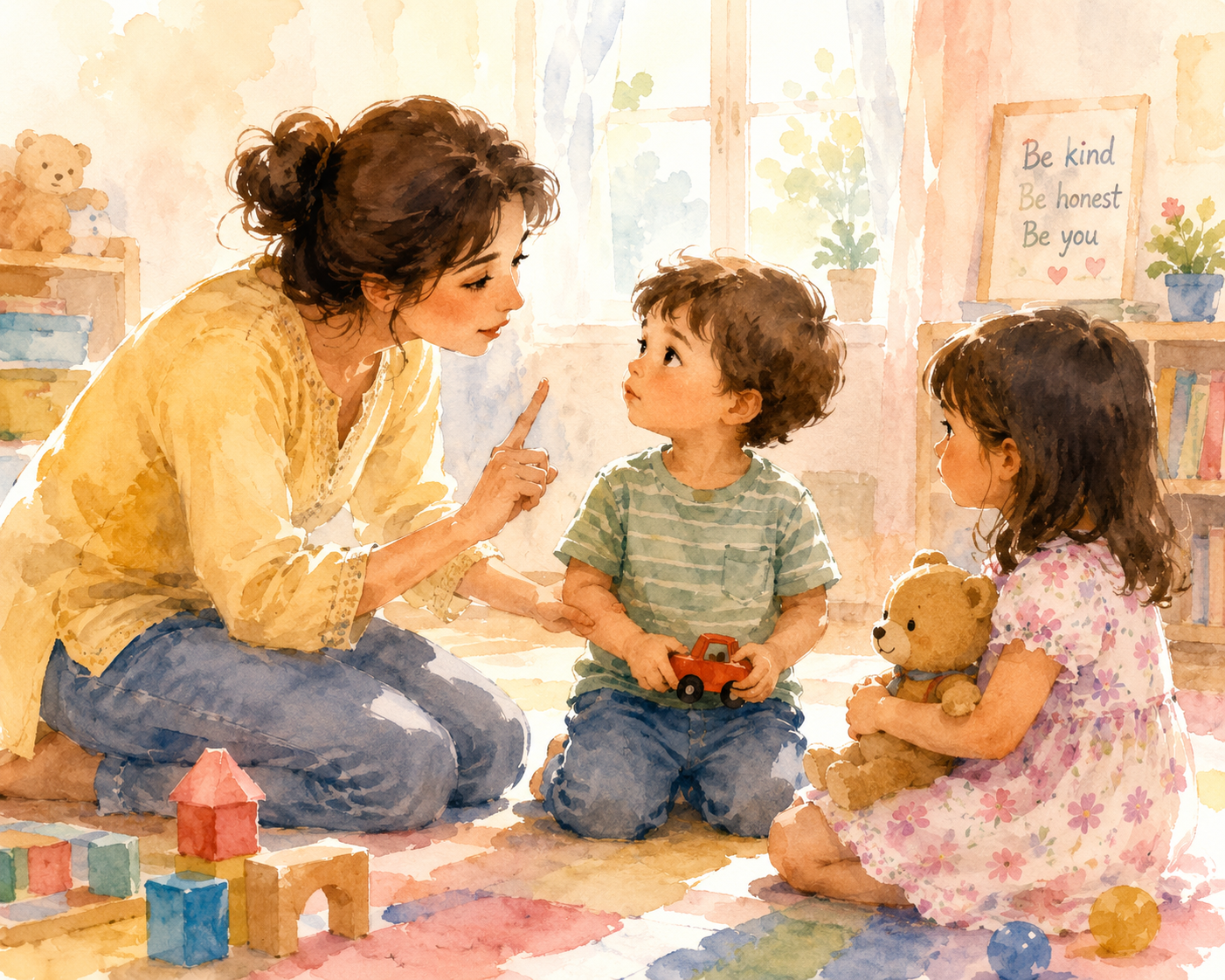
Every time you name your child's feelings instead of dismissing them, every time you comfort instead of shame, every time you repair after a hard moment, you are drawing a gentler map for them to carry into the world. You are teaching them, without a single lecture, that love is safe, and that they are worthy of it.
❦
The Same Night, a Different Story
Let us return to Meera and Kabir, and imagine the same night unfolding a little differently.
At 11:40, Meera notices the story her mind is starting to write. She recognises it. This is the old fear, she tells herself. I don't actually know what his silence means. Instead of sending three more messages, she sends one: "Hey, I get a little worried when I don't hear back. No pressure, just let me know you're home safe?"
Across the city, Kabir feels the familiar tightening in his chest. But this time he notices it too. She's not trying to trap me, he thinks. She just wants to know I'm okay. He picks the phone back up and types: "Home. Sorry, long day and I zoned out. Talk tomorrow? ❤️"
Nothing dramatic has happened. No grand gesture, no breakthrough. Just two small moments where two people chose a new step instead of the old one.
But this is how security is built. Not in a single moment of transformation, but in a thousand quiet choices to stay, to speak, to reach, and to return.
❦
The child in you learned how to love from the people who were there, or the people who weren't.
The adult in you gets to decide what love will look like from here.
❦
This article is intended for reflection and self-understanding, not diagnosis. If your relationship patterns are causing you significant distress, a qualified therapist or counsellor can be a wonderful companion on the journey.