(How child psychology helps us support a child's emotional, social and cognitive growth, so they can grow up confident, connected and resilient.)
❦
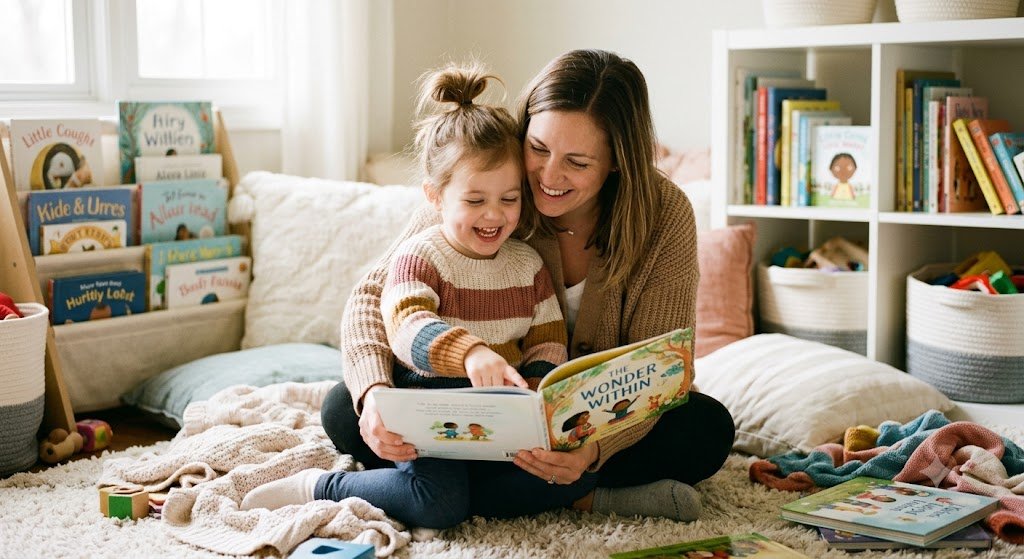
There is a wise old truth that every gardener knows: you cannot make a plant grow.
You cannot pull a seedling upward by its leaves, or command a mango tree to fruit before its season. What you can do is prepare the soil, give water and sunlight, protect it from harsh storms, and then trust the quiet, invisible work of growth.
The developmental psychologist Alison Gopnik made this image famous in her book The Gardener and the Carpenter. A carpenter, she observed, works to a fixed plan, shaping wood into a finished product. A gardener creates the conditions in which something living can flourish in its own way. Children, she argues, need gardeners.
This is the heart of nurturing a healthy mind. Not moulding a child into a perfect shape, but tending the soil in which their thoughts, feelings and friendships can grow strong. And the good news, confirmed by decades of research, is that the most powerful nutrients are not expensive classes or clever gadgets. They are things every loving parent already has to give.
This article brings together what the science says, in plain language, so you can understand what truly matters, and what you can quietly let go of.
❦
What Is a "Healthy Mind", Really?
A healthy mind does not mean a child who is always happy. It does not mean a child who never cries, never struggles, and never throws a tantrum in the supermarket.
The World Health Organization describes mental health as a state of well-being that allows us to cope with the ordinary stresses of life, to realise our abilities, to learn well, and to contribute to our community. For a child, that looks like something beautifully ordinary: the ability to feel sad and recover, to get angry and calm down, to make a friend and repair a quarrel, to try something difficult and try again.
Child psychologists often describe healthy development in three connected strands.
Emotional growth is how a child understands and manages their feelings.
Social growth is how they connect with others: making friends, sharing, empathising, belonging.
Cognitive growth is how they think, learn, pay attention, solve problems and stay curious.
These are not three separate subjects, like maths, science and English. The Center on the Developing Child at Harvard University describes emotional well-being and social skills as the foundation on which thinking skills are built. A frightened, lonely child cannot learn well, however bright they are. A child who feels safe and connected is free to think, explore and grow. Nurture the heart, and you nurture the mind.
❦
Why This Matters More Than We Realise
It is tempting to think of mental health as a grown-up concern. The research tells a different story.
A 2024 report from the World Health Organization and UNICEF found that around one in seven young people aged 10 to 19 is living with a mental health condition, with anxiety, depression and behavioural difficulties among the most common. The same report found that a third of mental health conditions begin before the age of 14, and half before 18. And according to the WHO, most of these conditions go unrecognised and untreated. Closer to home, India's National Mental Health Survey found that about 7.3% of adolescents aged 13 to 17 were living with a mental health condition.
These numbers are not here to frighten you. They are here to make one thing clear: childhood is not the waiting room of mental health. It is where mental health is built. And because a child's brain is so adaptable, childhood is also the time when care and early support make the greatest difference.
❦
The Brain Is Built, Not Born
Here is one of the most astonishing facts in all of science. In the first few years of life, a child's brain forms more than a million new neural connections every second.
Scientists at Harvard's Center on the Developing Child explain that the brain is built over time, from the bottom up, rather like a house. Simple connections form first, and more complex ones are built on top of them. Early experiences decide whether that foundation is sturdy or fragile, and the brain is most responsive to experience in the earliest years.
What builds those connections? Not flashcards. Not educational apps. The single most important ingredient is something the researchers call serve and return.
A baby babbles, points, or cries. That is the "serve." An adult responds with a smile, a word, a hug, or a question. That is the "return." Back and forth, like a gentle game of tennis, these tiny exchanges wire the circuits that support language, emotional balance and social skills. When a child's serves are consistently ignored, the Harvard researchers note, the absence of response can itself become a source of stress for the developing brain.
For older children, serve and return simply grows up. It is the conversation in the car, the story about a friend that you listen to all the way to the end, the drawing you look at properly instead of glancing at over your phone. The game never really stops. It just changes its rules.
❦
Pillar 1: One Steady, Loving Relationship
If you remember only one thing from this article, let it be this.
When researchers ask why some children grow up strong despite serious hardship, while others struggle, the answer that appears again and again is remarkably simple. The Harvard Center reports that the most common factor among children who develop resilience is at least one stable, committed relationship with a supportive adult: a parent, grandparent, teacher, or other caring grown-up.
These relationships act as a buffer between the child and life's storms. They also help children develop the inner skills of planning, self-control and adapting to change that allow them to face difficulty on their own.
What this looks like in everyday life. Psychologists describe the most supportive parenting as a blend of warmth and structure. Warmth means affection, attention, and letting your child know they are loved even when they misbehave. Structure means clear, calm, consistent limits: routines, rules and expectations that make a child's world feel predictable and safe. Children need both. Warmth without limits can leave a child anxious and unanchored. Limits without warmth can leave a child obedient but afraid.
A simple daily practice. Offer ten or fifteen minutes of undivided attention each day. No phone, no correcting, no teaching. Just follow your child's lead in play or conversation. For many children, this small, predictable window of connection becomes the anchor of their day.
❦
Pillar 2: Emotional Health — Every Feeling Is Welcome
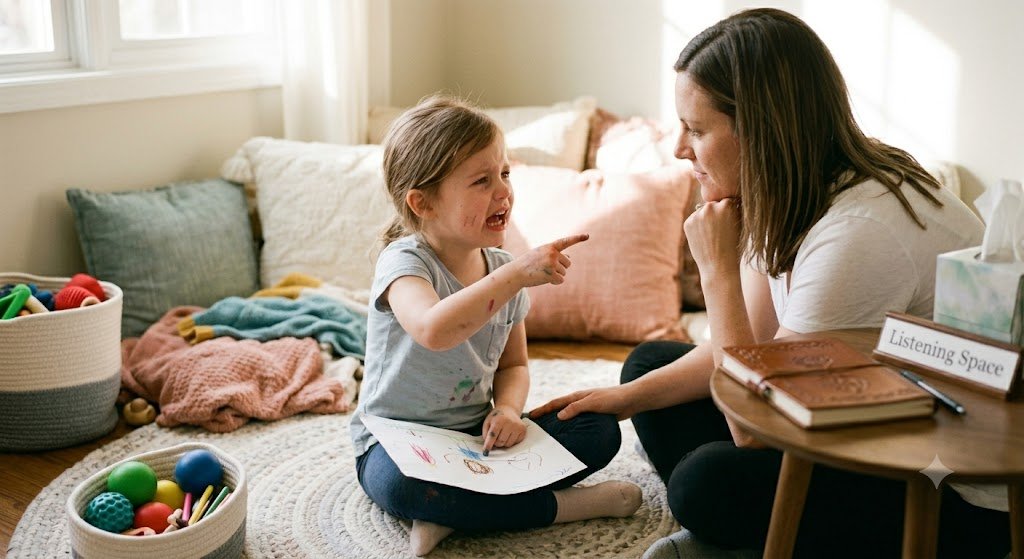
Many of us grew up hearing: Don't cry. Stop being silly. There's nothing to be scared of. These words were usually meant kindly. But they quietly taught a generation of children that feelings are problems to be hidden.
The psychologist John Gottman spent years studying how parents respond to their children's emotions. He found that parents who treated a child's emotional moments as opportunities for connection and teaching, an approach he called emotion coaching, tended to raise children who were better at calming themselves, focusing their attention, and getting along with others.
Emotion coaching is simpler than it sounds.
Notice the feeling, especially the small ones, before they grow into storms.
Name it for them. "You seem really disappointed that the park is closed." The psychiatrist Daniel Siegel calls this "name it to tame it": putting a feeling into words actually helps the brain settle it.
Accept the feeling, even when you limit the behaviour. "It's okay to feel angry. It's not okay to hit. Let's find another way to show how cross you are." All feelings are allowed. Not all actions are.
Solve the problem together, once the storm has passed. "What could you do next time your brother takes your toy?"
Show them how it's done. Children learn emotional regulation mostly by watching us. When you say, "I'm feeling frustrated, so I'm going to take three deep breaths," you are teaching a lesson no worksheet ever could.
❦
Pillar 3: Social Health — Learning to Belong
Children are born with a deep need to belong. Friendships are not a distraction from growing up. They are one of the main ways children learn empathy, cooperation, patience and forgiveness.
Let them practise. Social skills grow through real experience: sharing a swing, taking turns in a game, sorting out small quarrels. Where it is safe, resist the urge to step in immediately when children disagree. Instead, help them find the words: "Tell her how you felt when she took your crayon."
Rehearse the hard moments through play. Children often find it easier to practise tricky situations through pretend play or role-play: joining a group in the playground, saying sorry, standing up to teasing. A few minutes of playful rehearsal at home can give a shy child the confidence to try it for real.
Grow empathy through everyday questions. When reading a story, watching a film, or noticing someone upset, ask: "How do you think he is feeling? What might help?" Empathy is a muscle, and small, daily questions strengthen it.
Watch for loneliness and bullying. A child who suddenly doesn't want to go to school, loses friends, or comes home unusually quiet may be struggling socially. Ask gently, listen fully, and keep in touch with teachers.
❦
Pillar 4: Cognitive Health — Curiosity Over Marks
In many homes, and certainly in many Indian homes, a child's mind is measured in marks. Tests and results matter, of course. But a healthy mind is not simply one that scores well. It is one that stays curious, keeps trying when things get hard, and enjoys the adventure of learning.
Protect play. The American Academy of Pediatrics has described play as essential to healthy brain development, helping children build language, problem-solving, self-control and social skills. Free, unstructured play, such as building forts, inventing games, making mud pies and pretending, is not wasted time. It is some of the most important learning a child will ever do.
Praise the effort, not the label. Instead of "You're so clever," try "You worked really hard on that," or "I love how you kept trying different ways." Praising effort and strategies teaches children that ability grows with practice, and makes them more willing to take on challenges.
Welcome questions, even the ones you can't answer. Saying "I don't know, let's find out together" teaches a child that learning is a lifelong adventure. (We wrote a whole article about the power of these three words.)
Allow a little boredom. A child who is never bored never has to invent something to do. Some of the most creative ideas are born in empty afternoons.
Read together, every day. Reading aloud builds vocabulary, imagination, attention and closeness all at once. And it doesn't have to stop when children learn to read on their own.
❦
Pillar 5: The Body Looks After the Mind
We sometimes forget that the mind lives in a body. Sleep, movement, food and time outdoors are not separate from mental health. They are its daily foundation.
Sleep. Sleep is when the brain sorts memories, clears waste and resets emotions. A tired child is far more likely to be irritable, anxious and unfocused. Paediatric sleep experts recommend the amounts shown in the table below. A calm, consistent bedtime routine, and keeping screens out of the bedroom at night, are among the most powerful things a family can do.
Movement. The WHO recommends that children aged 5 to 17 get an average of at least 60 minutes of moderate-to-vigorous physical activity every day. Running, cycling, dancing, climbing and playing outside are good for the brain as well as the body. Physical activity helps release tension and supports mood, sleep and concentration.
Nourishment. Regular meals, including breakfast, help keep energy and mood steady through the school day. There is no need for perfection, only for rhythm and variety. Family mealtimes, even a few times a week, are also precious moments for connection.
Screens. Screens are part of modern life, and not all screen time is harmful. What matters most is what screens replace: sleep, play, movement, reading and conversation. For young children, the WHO advises no sedentary screen time for babies under two (apart from video calls with family, which experts generally consider fine), and no more than an hour a day for children aged 2 to 4. For older children, there is no single magic number. Instead, agree on clear family limits, keep devices out of bedrooms at night, and stay interested in what your child watches and plays.
❦
A Healthy Mind, Day by Day
|
Age |
Sleep (per 24 hours) |
Daily active play |
Screen guidance |
|
1–2 years |
11–14 hours, including naps |
At least 3 hours of varied activity |
None before 2, apart from video calls with family |
|
3–5 years |
10–13 hours, including naps |
At least 3 hours, with 1 hour energetic |
No more than 1 hour a day (until age 4) |
|
6–12 years |
9–12 hours |
At least 60 minutes energetic |
Clear family limits; no screens at bedtime |
|
13–18 years |
8–10 hours |
At least 60 minutes energetic |
Agreed limits; protect sleep and real-world time |
Sources: American Academy of Sleep Medicine; World Health Organization guidelines on physical activity, sedentary behaviour and sleep.
❦
Resilience: Stress Is Not the Enemy
It is natural to want to protect our children from every difficulty. But a completely stress-free childhood is neither possible nor healthy.
Harvard researchers describe three kinds of stress. Positive stress is brief and mild: the nervous flutter before a school performance, the first day at a new class. It is a normal and healthy part of growing up. Tolerable stress is more serious, such as the loss of a loved one or a frightening accident, but it becomes manageable when a caring adult helps the child through it. Toxic stress is strong, frequent or prolonged adversity, such as abuse, neglect or ongoing violence, without adequate adult support. This kind of stress can disrupt healthy brain development.
Notice the difference between them. It is not only the event itself. It is whether a loving adult is there to help the child carry it.
This means our job is not to remove every obstacle from our children's path. It is to walk beside them as they meet those obstacles. Let them struggle a little with a hard puzzle before stepping in. Let them feel the disappointment of losing a game, then help them recover. Every small challenge faced with support builds a little more inner strength.
❦
Look After the Gardener
A tired, anxious, overwhelmed parent cannot pour from an empty cup, and children notice everything. They absorb our moods, our worries and our ways of coping.
This is not a reason for guilt. It is a reason for kindness towards yourself. Sleep when you can. Ask for help. Talk to friends. Take a walk. Seek support if you are struggling. When you look after your own mental health, you are not being selfish. You are showing your child, in the most powerful way possible, that minds deserve care.
And when you lose your temper, as every parent does, remember that children don't need perfect parents. They need parents who come back and repair. "I'm sorry I shouted. That wasn't fair. I love you." Those words teach more about healthy relationships than a lifetime of flawless behaviour ever could.
❦
Knowing When to Seek Help
Every child has hard days, difficult weeks and challenging phases. Tantrums, clinginess, moodiness and a need for privacy are often completely normal parts of growing up.
Experts suggest paying closer attention when difficulties last for two weeks or more, appear in more than one setting (at home and at school, for example), or interfere with daily life: sleep, eating, learning, or friendships.
Signs that are worth discussing with a professional include:
Changes in mood: sadness that lingers, frequent tearfulness, or unusual irritability. In children, depression often shows up as irritability and anger rather than obvious sadness.
Changes in behaviour: withdrawing from friends, losing interest in activities they used to love, frequent outbursts, or behaviour that feels out of character.
Changes in the body: trouble sleeping, changes in appetite or weight, or frequent headaches and stomach aches without a clear medical cause.
Changes at school: falling grades, trouble concentrating, or not wanting to go to school at all.
If your child talks about wanting to hurt themselves, or talks about death or not wanting to be alive, do not wait. Seek help immediately.
Where to begin. Start by talking to your child's paediatrician, school counsellor or teacher, who can help you understand what you are seeing. A child psychologist or child psychiatrist can offer a proper assessment and support. In India, Tele-MANAS, the Government of India's free national mental health helpline, is available 24 hours a day on 14416 or 1800-891-4416, in English and many regional languages. Parents can call too, whether for guidance or simply to talk through a worry.
Seeking help is not a sign that you have failed as a parent. It is one of the most loving things a parent can do. Early support works, and the earlier it comes, the better.
❦
The Quiet Work of Growing
Go back, for a moment, to the gardener.
She does not stand over her plants every hour, anxiously measuring their height. She does not blame herself for every storm or every wilted leaf. She simply returns, day after day, with water, sunlight and patience. She clears away what harms. She protects what is fragile. And then she trusts the quiet, invisible work of growth.
Nurturing a healthy mind is much the same. It is not built in grand gestures, but in thousands of small, ordinary moments. A feeling named. A question answered. A bedtime story. A hug after a hard day. An "I'm sorry" after an unkind word. A walk in the evening air.
None of these things will ever appear on a report card. But they are, quietly and certainly, the soil in which a child's whole life will grow.
"Tend the soil. Trust the seed. And never underestimate the power of simply being there."
This article is for information and reflection, and is not a substitute for professional advice. If you are worried about your child's mental health, please speak to a qualified healthcare professional.